Three governments announced, within the same statement, three different versions of what just happened to Greenland. Donald Trump posted that the United States has secured “permanent control over security” on the island and will “FOREVER have the complete ability to do what is necessary in Greenland.” Danish prime minister Mette Frederiksen welcomed “the prospect of a good agreement” that recognises Denmark’s “sovereignty and territorial integrity.” Greenland’s prime minister, Jens-Frederik Nielsen, said the agreement “recognises Greenland’s interests and our place in international cooperation.”
Those are not the same claim. One side is describing a permanent American security guarantee that survives even Greenlandic independence. The other two are describing an arrangement that leaves sovereignty exactly where it already sat. Both readings can be checked against what has actually been reported about the text, and this piece checks them rather than picking the more dramatic one.
What the three governments actually announced
| When | What happens |
|---|---|
| Friday–Saturday, 18–19 September 2026 | US, Denmark and Greenland jointly announce the agreement is reached |
| Following week | Expected signing on the sidelines of the UN General Assembly in New York |
| After signing | Agreement must pass national parliamentary procedures in Denmark and Greenland before taking effect |
| No fixed date | Trump says the US will “immediately” begin developing a larger military presence |
That middle row matters more than the coverage has generally treated it. A signature at the UN General Assembly is a diplomatic event, not a ratified treaty. Denmark’s parliament, the Folketing, and Greenland’s own parliament, the Inatsisartut, both have to act on it before the terms bind either government domestically — which is also where a Greenlandic legislature genuinely opposed to a provision would have its one real point of leverage.
What the agreement actually contains
| Provision | What it does |
|---|---|
| NATO-exclusivity clause | Bans any non-NATO country from establishing a military base or troop presence in Greenland |
| Investment screening | Blocks Russian and Chinese investment the US or Denmark judge to be sensitive, without prior approval |
| Expanded US presence | Authorises the US to develop a larger military footprint on the island, effective immediately per Trump’s statement |
| Duration | No expiration date reported; Trump’s own statement says it applies even if Greenland becomes independent of Denmark |
| Sovereignty language | Danish and Greenlandic statements both describe the agreement as recognising existing sovereignty and self-determination, not transferring it |
Secretary of State Marco Rubio put the American framing most plainly: “Greenland will forever be part of the strategic defense area of North America and exclude any adversary from it.” That is a statement about exclusion — keeping Russia and China out — rather than a statement about ownership, and the distinction is doing a lot of quiet work in how each government has chosen to describe the same document.
Why Greenland, in one table
None of this is happening because of Greenland’s size on a map. It is happening because of what sits underneath the ice and what sits on top of it.
| Measure | Figure |
|---|---|
| Population | About 56,000 — the least densely populated country in the world |
| Land area | Roughly 2.16 million km², the world’s largest island |
| Rare earth element reserves (USGS estimate) | 1.5 million tonnes, ranking Greenland 8th globally |
| Kvanefjeld deposit alone | Estimated over 11 million tonnes of rare earth resources and reserves |
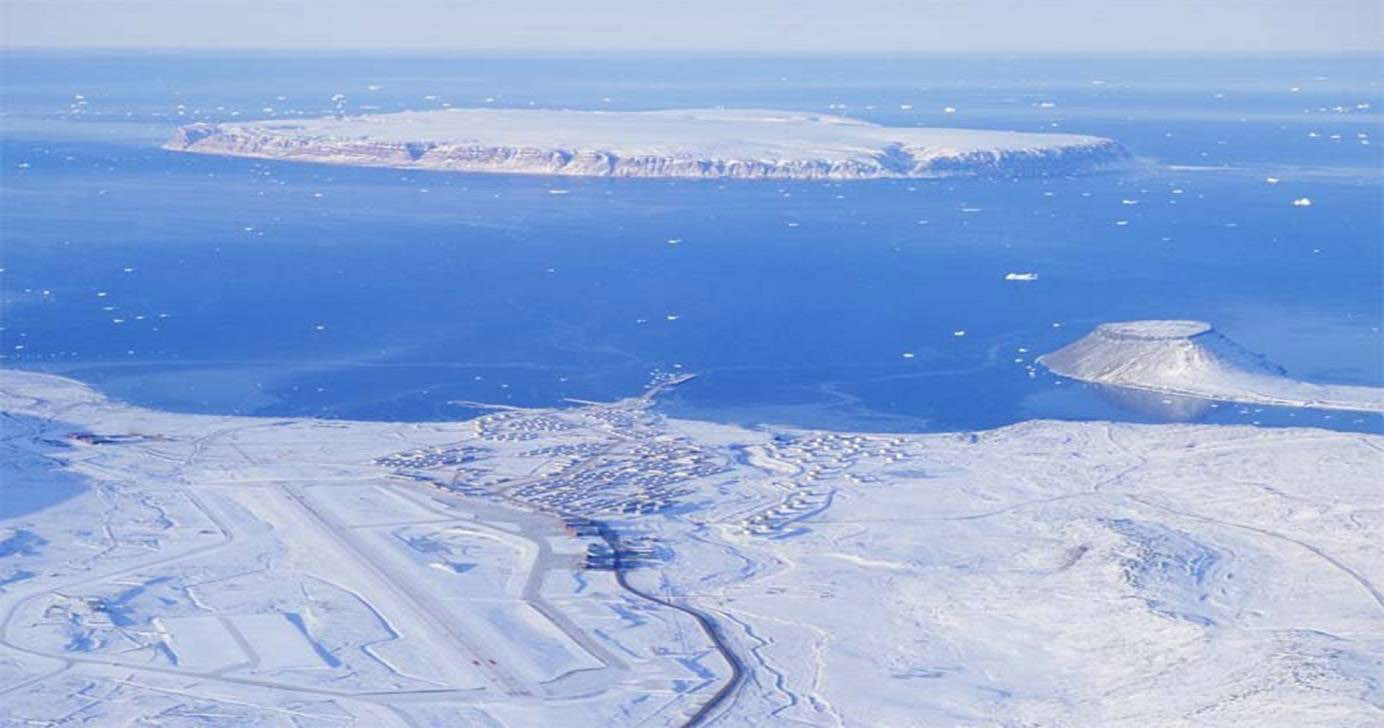
| US installation | Pituffik Space Base (formerly Thule Air Base) — missile warning, missile defence and polar satellite surveillance |
| Legal basis for US presence | 1951 Defense of Greenland treaty between the US and Denmark, amended 2004 |
The military logic and the mineral logic are two separate arguments that happen to point at the same island. Pituffik sits closer to Moscow over the Arctic than most of the continental United States does, which is why it has hosted American missile-warning radar since the Cold War under a 1951 treaty that predates NATO expansion, satellite navigation and, for that matter, most of the people currently negotiating over it. The minerals case is newer and largely still theoretical: reserves this large do not automatically translate into mines, refineries or exports, and Greenland currently has none operating at meaningful scale.
The rare earths story is really a uranium story
China’s dominance of the rare earths supply chain is the backdrop most coverage of Greenland’s minerals reaches for, and the numbers behind it are genuinely stark: China accounts for roughly 69% of global rare earth mining and a reported 85–90% of the processing and refining that turns ore into usable material, according to industry analysis cited by Mining Technology and the Michigan Journal of Economics. Western access to a rare-earth source outside that supply chain is a real strategic goal, and Greenland’s deposits are large enough to matter to it.
What gets lost is that Greenland’s largest deposit, Kvanefjeld, is not stalled by American or Danish pressure at all — it is stalled by Greenland’s own government. The site’s rare earths are laced with uranium, and Greenland’s Inuit Ataqatigiit party won the 2021 election partly on a platform opposing uranium mining. Greenland’s own Ministry of Mineral Resources rejected a licence renewal application for the project as recently as this year. China’s Shenghe Resources holds a stake in Kvanefjeld’s Australian majority owner, Energy Transition Minerals, which is the detail usually cited as the “Chinese foothold” in Greenland’s minerals sector — but the project it is invested in is the one Greenland has actually blocked, on domestic environmental grounds that predate Trump’s renewed interest in the island by several years.
The argument that the deal gives Washington nothing it didn't already have
Not every read of the agreement treats it as a genuine American gain. Praveen Swami, a contributing editor at ThePrint, argued in a 20 September 2026 analysis that the “permanent access, basing and overflights rights” and the power to build additional military structures that Trump is presenting as new concessions were, in substance, already available to the United States under the 1951 treaty — and that the confrontational route taken to get a document restating them has cost something real: “hard-won trust, not braggadocio or bullying,” in Swami’s words, is what the transatlantic security relationship has actually run on since the Cold War.
That argument holds up better than it might sound, once the history behind the 1951 treaty is laid out rather than assumed. The US presence in Greenland has never been a passive arrangement Washington politely renews every few decades — it has repeatedly gone further than what either government told the Greenlandic or Danish public at the time.
| When | What happened |
|---|---|
| 1951 | Defense of Greenland treaty signed, granting the US defence areas, airspace and anchorage rights on the island |
| 1959 | US Army Corps of Engineers builds Camp Century, publicly described as an Arctic research station |
| 1959–1963 | Camp Century secretly covers Project Iceworm — a classified plan for up to 600 nuclear missiles in a proposed 2,500-mile tunnel network under the ice, kept hidden even from Denmark’s own government; abandoned by 1963 as the ice sheet crushed the tunnels |
| 21 January 1968 | A US B-52 carrying four hydrogen bombs crashes on the sea ice near Thule; conventional explosives detonate on impact, scattering radioactive debris, and one weapon’s secondary stage is never recovered |
| 1995 | A Danish government report reveals Copenhagen had secretly allowed US nuclear weapons on Greenland for years, in violation of Denmark’s own 1957 nuclear-free-zone policy — triggering a domestic political scandal |
| 10 May 2021 | Denmark passes its own Investment Screening Act, already giving Copenhagen mandatory-authorisation power over sensitive foreign investment, including in dual-use and critical-technology sectors |
Read against that history, Swami’s argument is specifically that two of this week’s headline provisions restate authority Washington and Copenhagen already had rather than create new authority. The US has operated an expanding military footprint on Greenland, including installations Denmark itself was not fully informed about, since 1951. And Denmark has held its own legal power to screen sensitive foreign investment — the exact function the new agreement’s investment-screening clause performs — since 2021, independent of anything Trump negotiated this month.
How we got here: the Trump-Greenland timeline
| When | What happened |
|---|---|
| August 2019 | Trump floats buying Greenland as “essentially a real estate deal”; Frederiksen calls the idea “absurd” and Trump cancels a planned state visit to Denmark |
| Early 2025 | After re-election, Trump renews the push and repeatedly declines to rule out annexation, drawing pushback from Denmark, Greenland and European allies |
| January 2025 | Verian polling finds 85% of Greenlanders oppose joining the US; 6% support it |
| March 2025 | Vice President JD Vance visits Pituffik Space Base on a trip scaled back amid local criticism; Greenland’s then-acting leader says no invitation was extended |
| Through 2025 | Trump tells NBC News he will “never take military force off the table” regarding Greenland |
| 19 September 2026 | US, Denmark and Greenland announce the security agreement described in this piece |
I never take military force off the table.
That line, delivered to NBC News during the period covered above, is the reason this week’s agreement is being read by nearly every outlet as a climbdown rather than a victory lap for anyone. A government that spent a year not ruling out taking territory by force, then signs a document that leaves the territory’s sovereignty explicitly with its existing owner, has moved — whichever side of that movement you think looks better for Washington.
Denmark spent 2025 arming up around the same island
While the Trump administration was publicly declining to rule out military force, Denmark was quietly doing the one thing that actually changes facts on the ground: spending money on its own Arctic defences. The pattern of announcements reads less like routine budgeting and more like a government responding to pressure in real time.
| When | Announcement |
|---|---|
| December 2024 | $1.5bn package for Greenland, which Copenhagen said had already been planned before Trump’s comments |
| January 2025 | 14.6bn kroner (~$2.05bn) Arctic package: three new naval vessels, two long-range surveillance drones, expanded Arctic basic training |
| Later in 2025 | A further $4.2bn increase earmarked for security in Greenland, the Arctic and the North Atlantic |
| Later in 2025 | $4.5bn commitment to buy 16 additional F-35 fighter jets from the United States |
Read individually, each of those is a defence-budget story. Read together, across a single year, they describe a small NATO member roughly doubling down on the one Arctic territory a much larger ally was simultaneously threatening to take from it — while also buying that same ally’s fighter jets. Denmark’s own framing throughout was that the threat environment in the Arctic had genuinely worsened, which is true independent of Trump; Russian military activity in the region has increased steadily since 2022. But the timing, running almost exactly alongside the American pressure campaign, is not something either government has needed to spell out.
What Greenlanders actually think
The polling on this is more precise than most of the coverage lets on, largely because two separate questions keep getting merged into one.
| Question | Result |
|---|---|
| Do you want Greenland to join the United States? | 85% no, 6% yes, 9% undecided |
| Do you support independence from Denmark? | 56% in favour |
| Would you still support independence if it lowered living standards? | 45% opposed under that condition |
| Is Trump’s interest in Greenland a threat or an opportunity? | 45% threat, 43% opportunity, 13% undecided |
The near-even split on whether Trump’s interest is a “threat” or an “opportunity” is the more genuinely unsettled number here, and it is worth taking at face value rather than resolving it in either direction: a population can rationally see American strategic attention as simultaneously dangerous to its autonomy and useful as leverage against Copenhagen, and 45-to-43 suggests that is closer to where Greenlandic opinion actually sits than either “Greenland welcomes this” or “Greenland is alarmed” would imply on its own.
What NATO and the wider region are saying
That is also why Denmark had a real incentive to reach an agreement rather than continue managing a year of American pressure with no resolution: a negotiated arrangement that keeps formal sovereignty in Copenhagen is a materially better outcome for Denmark than an open-ended annexation threat from its most powerful ally, even if the security terms inside that arrangement run deep.
Final verdict
Strip away the framing each government has chosen and two things are true at once, without contradiction. Trump did not get the outright annexation he spent 2025 not ruling out by force — Greenland remains part of the Kingdom of Denmark, and both Copenhagen and Nuuk have said so on the record within the same announcement that Trump is calling a permanent security takeover. And Trump did get something substantial: a NATO-exclusivity guarantee, an investment-screening veto over Russian and Chinese money, an explicit green light to expand the American military footprint immediately, and — if the reporting on the duration clause holds — a security arrangement designed to survive Greenlandic independence itself.
The gap between “permanent control” and “sovereignty preserved” is not a translation problem between English, Danish and Greenlandic. It is two governments each publishing the version of this story that serves them, about a document neither has released in full. The actual test is not what anyone posted on Friday night — it is what the Folketing and the Inatsisartut are asked to ratify, and whether either legislature amends or rejects any part of it once the text is public.
Our read: watch the ratification process, not the announcement. A government that truly has “permanent control forever” would not need two other parliaments to sign off on anything. The fact that this one does is itself the clearest evidence of how much sovereignty actually changed hands this week — which, on the available reporting, is less than the loudest quote suggests and more than a routine defence-treaty update.
Frequently asked
- What did the US, Denmark and Greenland actually agree to?
- A security arrangement that lets the US expand its military presence in Greenland, bans any non-NATO country from basing troops there, and requires US or Danish approval for sensitive Russian or Chinese investment. Reporting on the announcement says it carries no expiration date and is described as applying even if Greenland becomes independent of Denmark. It has not yet been signed or ratified.
- Does this mean the US now controls Greenland?
- No. Denmark retains sovereignty and Greenland retains its right to self-determination, according to statements from both the Danish and Greenlandic governments issued alongside the announcement. Trump’s own language — “permanent control over security” — describes a security guarantee, not a transfer of territory or governance.
- Do Greenlanders want to join the United States?
- No. A Verian poll from January 2025 found 85% of Greenlanders oppose joining the US, with only 6% in favour. Separately, 56% support independence from Denmark — a different question that surveys and coverage frequently conflate with support for American statehood.
- When does the agreement take effect?
- It is expected to be signed on the sidelines of the UN General Assembly in the week following the 19 September 2026 announcement. After signing, it still needs to clear national parliamentary procedures in both Denmark and Greenland before it takes legal effect.
- Why does the US want a bigger presence in Greenland?
- Two separate reasons converge on the same island: Pituffik Space Base (formerly Thule Air Base) provides missile-warning and polar surveillance coverage the US has relied on since a 1951 treaty, and Greenland holds an estimated 1.5 million tonnes of rare earth element reserves — relevant given China’s roughly 69% share of global rare earth mining and 85–90% share of processing.
- Is China actually mining rare earths in Greenland?
- No. Greenland’s largest rare earth deposit, Kvanefjeld, is majority-owned by an Australian company in which China’s Shenghe Resources holds a minority stake — but the project itself has been blocked by Greenland’s own government since 2021 over opposition to the uranium mining the site would require, and its licence renewal was rejected again in 2026.
- Is the new agreement actually new, or does it just restate powers the US already had?
- Both readings have real support. ThePrint contributing editor Praveen Swami has argued the deal’s headline provisions — permanent basing and overflight rights, and investment screening — largely restate authority the US already held under the 1951 treaty and that Denmark already held under its own 2021 Investment Screening Act. Historically, the US has gone further in Greenland than either government disclosed at the time: the classified Project Iceworm nuclear-missile plan beneath Camp Century (1959–1963) was kept secret even from Denmark, and a 1995 Danish government report revealed Copenhagen had secretly permitted US nuclear weapons on the island for years. What is genuinely new in this agreement is an explicit, signed, trilateral document naming Russia and China — which has real diplomatic value even if much of the underlying legal authority already existed.