Five medals in two disciplines, on two days, from one shooting range. That is the compressed version of India’s start to the Asian Games 2026 shooting competition in Aichi-Nagoya, and the compressed version undersells it. The fuller version involves a 20-year-old wrestler-turned-marksman from a farming family in Haryana beating a reigning world champion in that world champion’s own final; a 27-year-old Olympian who had spent eight years and two previous Asian Games without a medal to show for either; and China, the sport’s dominant power for four decades, walking away from a final without a single shooter on the podium for the first time since Deng Xiaoping was in his first year running China's paramount post.
This is the full, score-by-score account of both finals, what actually happened in the closing exchanges of each, and what the results mean set against the athletes’ own histories.
The five medals, at a glance
Before the detail, the scoreboard. India’s shooting squad opened the Games with the women’s 10m air rifle on 20 September and followed it with the men’s event on 21 September — individual and team finals held on the same day in both cases.
| Shooter(s) | Event | Medal |
|---|---|---|
| Elavenil Valarivan | Women's 10m air rifle (individual) | Silver |
| Elavenil Valarivan, Sonam Maskar, Vidarsa Vinod | Women's 10m air rifle (team) | Silver |
| Himanshu Dhillon | Men's 10m air rifle (individual) | Silver |
| Rudrankksh Patil | Men's 10m air rifle (individual) | Bronze |
| Rudrankksh Patil, Parth Mane, Himanshu Dhillon | Men's 10m air rifle (team) | Silver |
Source: Olympics.com's official Asian Games 2026 shooting results table.
Four different shooters, five medals, and — as the qualification scores below show — not one of them arrived at the range as the outright favourite in their event.
The men’s final: a debutant beats the world champion he came up with
Start with the context that makes 21 September’s result unusual. Rudrankksh Patil did not arrive in Japan as a promising junior with an outside medal chance. He arrived as the reigning individual world champion, having won gold at the 2022 ISSF World Championships in Cairo — a title that made him only the second Indian, after Abhinav Bindra, to win an individual world championship in the discipline. He followed that with a team gold at the 2022 Hangzhou Asian Games and, weeks before Aichi-Nagoya, gold in both the individual and team events at the 2026 Asian Shooting Championships in New Delhi. On paper, this was his final to lose.
He very nearly won it. Patil started the final strongly, leading after the opening series with a score of 52.8, then extended that advantage with a 53.2 in the second series to move 1.1 points clear at the top of the field. What happened next is the part that does not show up in a results table: Patil faded across the closing series, while a 20-year-old teammate making his Asian Games debut kept climbing.
| Shooter | Qualification rank | Qualification score |
|---|---|---|
| Rudrankksh Patil | 3rd | 631.8 |
| Himanshu Dhillon | 7th | 630.0 |
| Parth Mane | 11th (did not qualify for final) | 628.8 |
Source: Olympics.com. Only the top eight qualifiers advance to the elimination final, which resets scores to zero and eliminates the lowest-placed shooter after each round.
| Rank | Shooter | Country | Final score |
|---|---|---|---|
| Gold | Sheng Lihao | China | 233.0 |
| Silver | Himanshu Dhillon | India | 231.0 |
| Bronze | Rudrankksh Patil | India | 230.9 |
Sources: The Hindu and India Today match reports. Patil's bronze-medal score is confirmed separately by Olympics.com's results table.
Two-tenths of a point separated silver from bronze. One-tenth separated bronze from missing the podium altogether. India Today’s account of the closing exchange puts the margin in sharp relief: with the final reduced to its last two shooters, both Sheng and Dhillon fired 10.6 with their final shots — Sheng’s cumulative score held at 233.0, Dhillon’s at 231.0, and gold went to China by the width of the earlier series rather than anything either man did on the last shot.
What Patil said about pressure, seventeen days before he needed it most
Two and a half weeks before that final, Patil gave an interview to ANI in Bhopal that reads differently in hindsight than it must have at the time. Aichi-Nagoya was set to be his first multi-event Asian Games — alongside the 10m air rifle, he was also entered in the 50m rifle 3 positions, individually and in the team event — and he was asked how he manages the specific pressure of a discipline where a single bad series can undo three good ones.
I get more focused during high-pressure events. That has been a very special thing which has been happening with me for many years, and I get excited with pressure that keeps me alive, that keeps me running. I’m looking for the pressure most of the time, and when I get it, I just enjoy it.
Rudrankksh Patil, speaking to ANI, 6 September 2026
He also credited teammates with 20 to 25 years of experience each for showing him, in his own words, how to stay “very chill about almost everything” and how to get out of a negative situation once it starts. Fifteen days later, his own final went from a 1.1-point lead after two series to a bronze medal — not a collapse by any reasonable definition, but exactly the kind of mid-final swing the pre-Games interview was describing in the abstract. Whether the composure he described held up is a fair question; the result suggests it held up enough to finish on the podium against a debutant teammate and an Olympic-calibre Chinese field, which is a different thing from not being tested at all.
From the wrestling mat in Jind to an Asian Games final
Himanshu Dhillon’s route to that final shot is the more unusual of the two Indian stories. He is 20, from Jind in Haryana, and according to India Today’s profile of him, shooting was not his first sport — he wrestled before switching disciplines, and comes from a farming background rather than the shooting-academy pipeline that has produced most of his teammates. Aichi-Nagoya was his Asian Games debut, in both the individual and team events, on the same day.
The team result came first. Dhillon shot 630.0 in team qualification, combining with Patil’s 631.8 and Parth Mane’s 628.3 for a total of 1890.1 — enough for silver, behind a Chinese total India Today reported as a world record 1899.0. Only after that result was confirmed did Dhillon go into the individual final and come out with a second silver of the day.
| Team | Shooters | Score | Medal |
|---|---|---|---|
| China | Not individually reported in Indian coverage | 1899.0 (world record) | Gold |
| India | Rudrankksh Patil, Parth Mane, Himanshu Dhillon | 1890.1 | Silver |
China's team total per India Today's report of the day's results; the Indian total is corroborated by Olympics.com.
A day earlier: Elavenil Valarivan’s eight-year wait
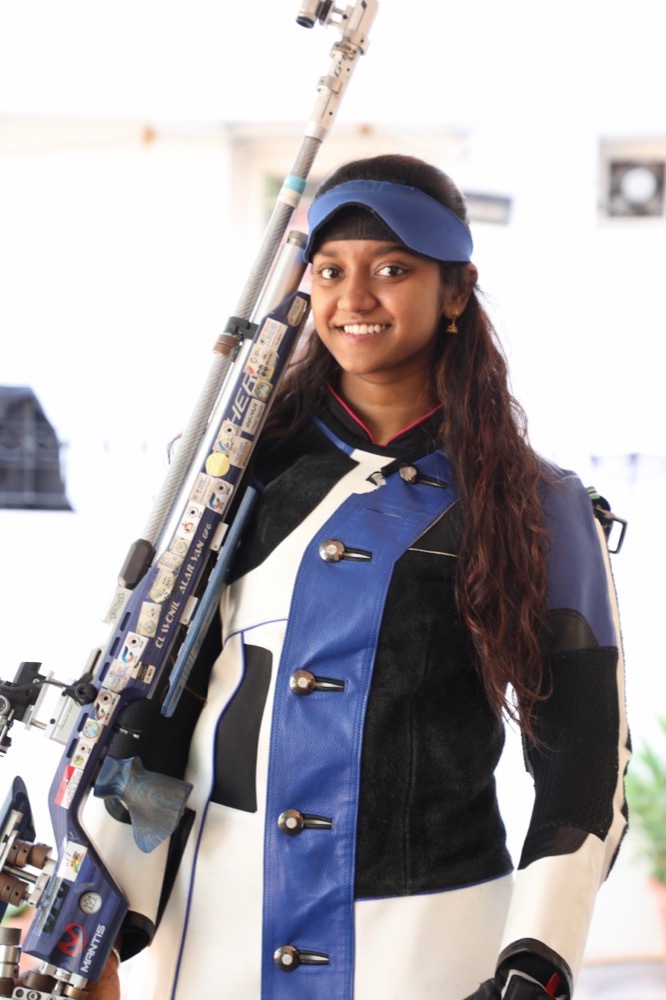
The women’s 10m air rifle final on 20 September set up the shape of the entire two days, and it did it on the back of a shooter who, on paper, needed this medal more than almost anyone else in the Indian contingent. Elavenil Valarivan is a seasoned Olympian — she competed at Tokyo 2020 and Paris 2024 — but had never won a medal at the Asian Games in two previous attempts, starting with her debut in Jakarta in 2018.
For most of Sunday’s final, that omission looked about to be corrected in the best possible colour. Valarivan built a lead of close to 1.5 points and carried it deep into the competition, according to the Press Trust of India’s account of the final published by YourStory. Then, with the contest almost decided, three loose shots let the field back in.
| Rank | Shooter | Country | Final score |
|---|---|---|---|
| Gold | Hinata Taichi | Japan | 253.0 (Asian Games record) |
| Silver | Elavenil Valarivan | India | 252.4 |
| Bronze | Ban Hyo-jin (reigning Olympic champion) | South Korea | 230.4 |
| 5th | Wang Zifei (2025 World Championship silver medallist) | China | 188.2 |
| 7th (eliminated at the 14th shot) | Han Jiayu (former world champion) | China | 145.2 |
Source: IndiaSportsHub's results breakdown, cross-checked against Olympics.com's table, which independently records Valarivan's score as 252.4.
Valarivan was characteristically unsparing about her own final in comments carried by PTI. “I did get a bit relaxed. I think I really need to work on my finals some more,” she said. “I knew that I was in the top three. Although I was coming back to focusing on my process and my technique, I did get a bit relaxed. Once the medal was assured, the pressure was released. It was more about me getting a little easy on my process.”
I felt I gave my absolute best. I think it is all a learning process.
Elavenil Valarivan, after the women's 10m air rifle final
It was her third successive individual silver at a major Asian competition, following the Asian Championships in Shymkent and in Delhi — a run that makes Sunday’s result look less like a near-miss and more like a pattern she is actively working through. Her account of what the medal meant personally was more direct than her account of the shooting itself: it had been eight years since her first Asian Games appearance in Jakarta, and this was the first time she had a medal to bring home from one. “It was more about being very grateful that I was getting the opportunity to be a part of the contingent and represent my country,” she said of the conversation she had with her coach before the final.
China’s rare miss — the first time in 40 years
The result that will likely be talked about longest from the women’s final, though, belongs to neither medallist. Both of China’s finalists — Wang Zifei, the reigning world championship silver medallist, and Han Jiayu, a former individual world champion — were eliminated before the medal positions, finishing fifth and seventh. According to IndiaSportsHub’s analysis of the result, it is only the second time in Asian Games history that China has left the women’s 10m air rifle individual final without a medal. The previous occasion was the 1986 Seoul Asian Games, the first edition to feature the event — 40 years, and ten editions, ago.
The medals instead went to the host nation, India and South Korea. Japan’s Hinata Taichi won gold with an Asian Games record of 253.0, on home soil, in front of a crowd that had travelled to Aichi Prefecture specifically to see it. South Korea’s Ban Hyo-jin, the reigning Olympic champion in the event, took bronze — meaning two of the three individual medals went to shooters who had already proven themselves at the very top of the sport, and the third went to an Indian shooter who had spent eight years trying to get onto an Asian Games podium at all.
The team events: two more silvers, and the number that explains both
Both individual finals were bookended, on their respective days, by team events in the same discipline — decided on cumulative qualification scores rather than a separate final. India won silver in both.
| Team | Shooters | Score | Medal |
|---|---|---|---|
| China | Wang Zifei, Du Yuchen, Han Jiayu | 1904.2 (world record) | Gold |
| India | Elavenil Valarivan, Sonam Maskar, Vidarsa Vinod | 1898.0 | Silver |
| Japan | Not individually reported in Indian coverage | 1897.1 | Bronze |
Source: IndiaSportsHub's results breakdown, corroborated by Olympics.com's table for the Indian total.
Both Indian team totals sit within 9-10 points of a Chinese team that set a world record on the same day — the gap is real but not the routine walkover the medal colour alone would suggest.
Put the two rows the other way round and the story is more flattering to India than “two silvers behind China” sounds on its own. China’s women’s team did not just win gold — it broke the world record while doing so, and still needed 1904.2 points to hold off an Indian trio finishing 6.2 points behind. On the men’s side, Patil, Mane and Dhillon closed to within nine points of a Chinese team total India Today separately reported as itself a world record. Both Indian team results were genuinely close finishes against the best team scores ever posted in the discipline, not distant runners-up finishes against an ordinary winning total.
India’s shooting pipeline, in the background
Patil’s 2022 world title made him the second Indian, after Bindra’s 2006 world championship gold and his 2008 Beijing Olympic gold, to reach the sport’s individual summit. That lineage matters for reading Aichi-Nagoya correctly: this was not a story of an Indian team overachieving against a weaker field. Patil arrived as the shooter everyone else in the final was trying to beat, and a teammate ranked below him in qualification did exactly that. India’s recent depth in 10m air rifle — Ramita Jindal’s individual bronze at the 2022 Hangzhou Asian Games is another data point IndiaSportsHub cites in the same event Valarivan won silver in this time — is now producing results across more than one shooter per Games, which is a different and harder thing to build than a single standout performer.
Patil’s own Hangzhou gold, in 2022, came in the same team event Mane and Dhillon nearly matched him in this time — that squad was Patil alongside Divyansh Singh Panwar and Aishwary Pratap Singh Tomar. Four years on, two of those three names have already been replaced by shooters younger than the medal they were trying to defend, and the replacements produced a silver rather than a repeat gold. Read one way, that is a step back from 2022. Read against the closeness of the final scoreline — nine points off a world-record Chinese total — it looks more like a squad in transition than a squad in decline.
The two days on the range, inside a bigger two days for India
The shooting range was not the only place India was winning at Aichi-Nagoya on 20 and 21 September. The Hindu’s own coverage of the same two days recorded a 19-0 hockey win over Uzbekistan built on an eight-goal haul from Deepika, a first Indian medal confirmed in mixed martial arts once Suchika Tariyal reached her semifinal, a straight-games win for India’s women’s table tennis team over Indonesia, and a women’s badminton team win over Kazakhstan that set up a quarter-final against the host nation. None of that is a shooting result, and none of it is claimed as one here — but it is the context a reader scrolling past the medal table that morning would have seen, and it is worth naming because it shows the shooting range’s five medals were not India’s only story from the opening two days, only its most decorated one.
What comes next for India’s shooting squad
None of that is a prediction — a mixed-team pairing and an individual final are different contests, and nothing above guarantees Mane and Valarivan a sixth medal on 22 September. It is, however, the correct context for reading two days of results: this is the opening act of a roughly two-week shooting competition, not the final medal count.
Final Verdict
The headline number from India’s first two days of Asian Games 2026 shooting is five medals. The more useful number is one-tenth of a point — the margin between Himanshu Dhillon’s silver and Rudrankksh Patil’s bronze, and a fair symbol for how the whole two days actually went. Nothing here was a walkover in either direction. Patil, the reigning world champion, did not have an off day so much as he had a final decided by a handful of shots against a teammate shooting the round of his life. Valarivan did not lose a gold medal to a better shooter so much as to three shots out of dozens, against a Japanese shooter who set an Asian Games record on home soil. And China did not have a bad Games — it broke a world record in the women’s team event on the very day its individual shooters missed the podium for only the second time in forty years.
Our read: the number worth remembering after the medal ceremonies fade is not the colour of any single medal but the margins that decided them. A sport this precise rarely hands out a wide verdict, and Aichi-Nagoya’s opening two days did not either — five Indian medals came from finals that, shot for shot, were as close as the discipline gets.
Frequently asked
- How many shooting medals did India win at the start of the Asian Games 2026?
- Five, across the first two days of competition in Aichi-Nagoya: Elavenil Valarivan’s individual silver and a women’s team silver on day one (20 September), followed by Himanshu Dhillon’s individual silver, Rudrankksh Patil’s individual bronze and a men’s team silver on day two (21 September) — all five in the 10m air rifle discipline.
- Who won India’s first individual shooting medal at these Games?
- Elavenil Valarivan, with silver in the women’s 10m air rifle final on 20 September. She led by roughly 1.5 points before three loose shots let Japan’s Hinata Taichi through to gold. It was Valarivan’s first Asian Games medal in three appearances, ending an eight-year wait since her 2018 debut in Jakarta.
- Why did world champion Rudrankksh Patil finish third instead of first?
- Patil, the 2022 world champion, led the men’s final after the opening two series before fading in the closing exchanges. China’s Sheng Lihao took gold with 233.0, debutant Himanshu Dhillon silver with 231.0, and Patil bronze with 230.9 — a margin of one-tenth of a point between silver and bronze.
- What happened to China in the women’s 10m air rifle event?
- Both Chinese finalists, 2025 World Championship silver medallist Wang Zifei and former world champion Han Jiayu, were eliminated before the medal positions, finishing fifth and seventh. It was only the second time since the event’s introduction at the 1986 Seoul Asian Games that China left the individual final without a medal — a streak that had held across every edition from 1990 to 2022. China still won the team gold in the same discipline with a world record score.
- Who is Himanshu Dhillon?
- A 20-year-old shooter from Jind, Haryana, competing at his first Asian Games. He wrestled before switching to shooting and comes from a farming background. He qualified 7th for the individual final with a score of 630.0 and then beat the field to take silver, having already won a team silver earlier the same day.
- When does India next compete for a shooting medal at the Asian Games 2026?
- The 10m air rifle mixed team event has its qualification and final on 22 September, the day immediately after the individual finals. India’s 30-member shooting squad, which also includes Manu Bhaker and Esha Singh, is entered across 28 events running through 1 October.