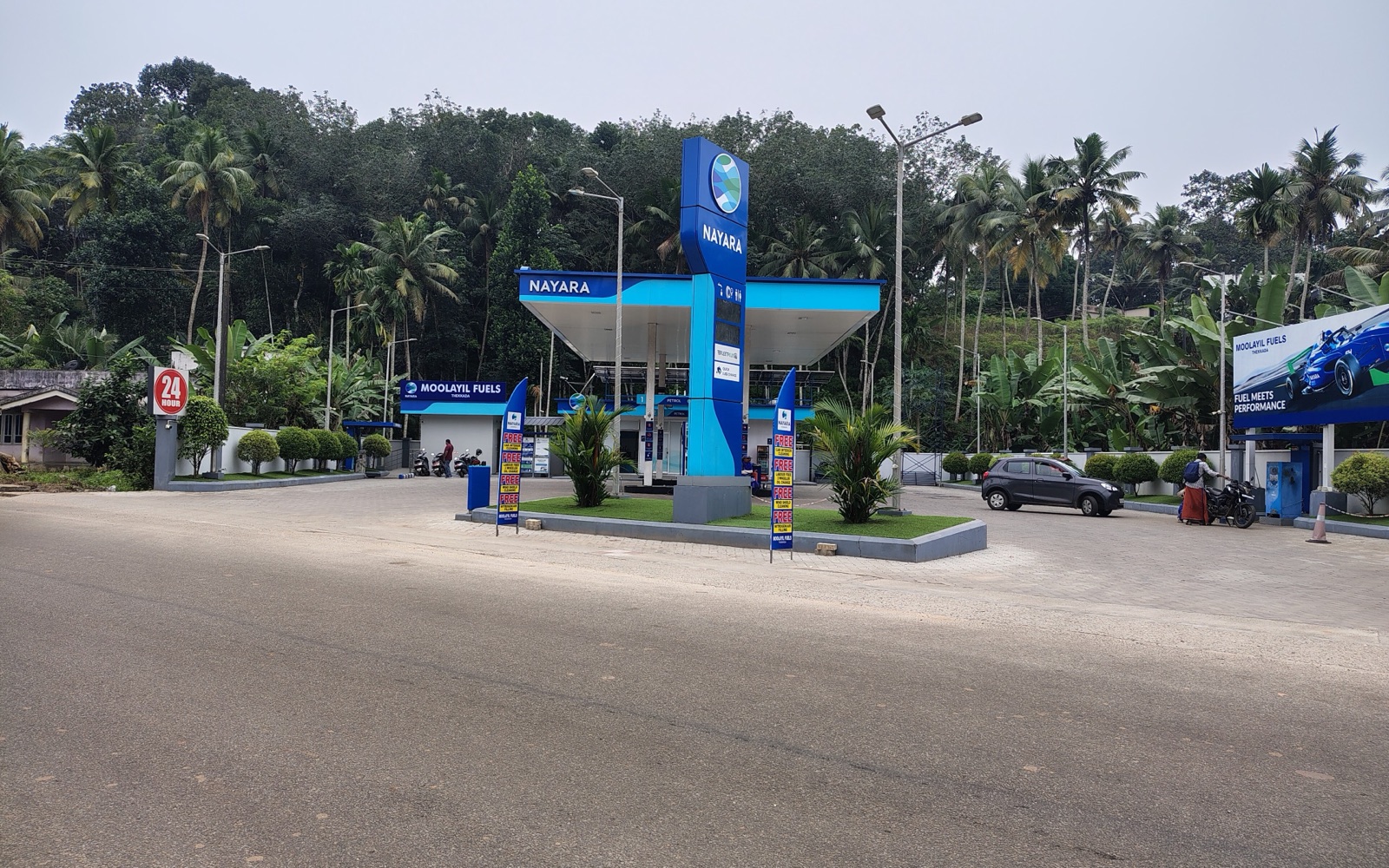
Did petrol just get ₹5 dearer at your pump? Only if it is a Nayara pump. Nayara Energy, the largest private fuel retailer in India, raised petrol by ₹5 a litre and diesel by ₹3 a litre across its 7,108 outlets from Saturday, 3 October. Indian Oil, Bharat Petroleum and Hindustan Petroleum have not changed their prices, and neither has Jio-bp.
The company blamed high international crude and fuel prices linked to the conflict in the Middle East, Business Today reported. It is the second time this year Nayara has raised prices by exactly these amounts: it did the same on 26 March and took the increase back on 1 July.
₹5 at 7,108 pumps, nothing at the other 97,000
India has 104,137 retail fuel outlets, according to Business Today, and the three state-run companies run more than 90% of them. Nayara’s 7,108 are about 6.8% of the total (7,108 ÷ 104,137). Jio-bp has 2,304 and has not announced a change.
At the state-run pumps, nothing moved. Indian Oil’s own price build-up for Delhi still shows petrol at ₹102.12 a litre and diesel at ₹95.20. State-run prices have not changed since May, according to Business Today and NiftyTrader. So for most drivers the practical effect is a wider gap between a Nayara pump and the Indian Oil or BPCL pump down the road, not a higher price everywhere.
Crude went up, down and up again, and Nayara followed it
The timing makes more sense against the price of crude that Indian refiners actually pay. The Petroleum Planning and Analysis Cell publishes a monthly average for the Indian basket, a mix of Brent and Oman-Dubai grades weighted by what Indian refineries import.
Source: Petroleum Planning and Analysis Cell, Crude Oil FOB Price (Indian Basket), report posted 5 October 2026. Monthly averages of daily prices; October covers the first trading days only. The basket stood at $120.73 on 2 October.
Lay Nayara’s moves over that chart and they line up. The March increase followed the supply disruption from the Iran conflict, and April’s basket averaged $114. State-run companies raised their own prices in May, when the basket averaged $106. By June and July it had fallen to around $82 to $83, and Nayara reversed its increase on 1 July. Then crude climbed again, to an average of $116 in September and above $120 in the first days of October, and Nayara put the ₹5 and ₹3 back.
Brent, the international benchmark, closed above $100 on four Fridays in a row, the last at $102.25 on 2 October, according to NiftyTrader.
What the state-run companies are swallowing instead
Indian Oil, BPCL and HPCL haven’t raised prices, but that doesn’t mean they aren’t paying for it. The rating agency ICRA estimated in September that their marketing margins were about minus ₹8 a litre on petrol and minus ₹9 on diesel, and that the three were losing around ₹530 crore a day across petrol, diesel and cooking gas, Business Standard reported.
Private retailers have no such cushion. Before the hike, both Jio-bp and Nayara had started limiting how much a customer could buy: Jio-bp capped diesel at 50 litres a day and Nayara set limits between 70 and 200 litres, according to NiftyTrader. On 1 October the government asked private retailers not to restrict sales, Business Today reported. Two days later, Nayara raised prices instead.
What ₹5 a litre costs in a month
The hike only matters if you keep filling up at Nayara. For anyone who does, it is simple arithmetic.
| Example | Fuel | Litres a month | Extra a month | Extra a year |
|---|---|---|---|---|
| Scooter, daily commute | Petrol (+₹5) | 15 | ₹75 | ₹900 |
| Hatchback, city driving | Petrol (+₹5) | 40 | ₹200 | ₹2,400 |
| Diesel SUV | Diesel (+₹3) | 80 | ₹240 | ₹2,880 |
| Diesel taxi or small goods vehicle | Diesel (+₹3) | 400 | ₹1,200 | ₹14,400 |
Illustration: monthly litres are round example figures, not survey data. Extra cost = litres × ₹5 for petrol or × ₹3 for diesel; yearly = monthly × 12, assuming the increase stays in place for a year.
The same arithmetic is the case for switching. If a state-run pump is on your route, buying there saves the whole ₹5 or ₹3, because their prices haven’t moved. For a fleet operator on diesel, that is the difference shown in the last row, every month.
What to watch
First, whether Jio-bp follows, since it is the other large private retailer and was already rationing diesel. Then, whether the state-run companies raise prices for the first time since May, which would close the gap but raise prices for everyone. And whether Nayara reverses again, as it did in July, if the Indian basket falls back towards the $80s. PPAC’s October figure, published daily, is the number to follow.
Frequently asked
- Have Indian Oil, BPCL and HPCL raised petrol prices too?
- No. The 3 October increase is Nayara’s alone. Indian Oil’s Delhi price build-up still shows petrol at ₹102.12 and diesel at ₹95.20 a litre, and state-run prices have not changed since May.
- How much has Nayara increased petrol and diesel prices?
- By ₹5 a litre on petrol and ₹3 a litre on diesel, from 3 October 2026, across all 7,108 Nayara outlets. Exact pump prices differ by state because of VAT.
- Why did Nayara raise prices?
- It cited high international crude and fuel prices tied to the Middle East conflict. PPAC data shows the Indian crude basket averaged $116.09 a barrel in September and stood at $120.73 on 2 October, up from about $82 in July, when Nayara had reversed an earlier increase.