
When someone dies, their money doesn’t disappear and it doesn’t go to the government. In India there is no inheritance tax, and every rupee in a bank account, a mutual fund or an insurance policy eventually reaches someone. The real questions are who gets it, how long it takes, and whether the person who collects it is allowed to keep it. Those turn out to be three different questions, and most of the arguments families have afterwards come from mixing them up.
Receiving the money is not the same as owning it
Start with the word that causes most of the confusion: nominee. A nominee is the person a bank, fund house or insurer pays when the account holder dies. For most kinds of money, that is all a nominee is. They collect it. They don’t necessarily get to keep it.
SEBI’s nomination circular of January 2025, which covers mutual funds and demat accounts, says so in one line: nominees receive the assets of a deceased sole holder “as trustee on behalf of legal heir(s).” The Supreme Court took the same view in December 2023 in Shakti Yezdani v Jayanand Jayant Salgaonkar, a dispute over fixed deposits and mutual fund units, holding that a nomination does not override the law of succession. The nominee holds the money for whoever inherits it under the will, or under succession law if there is no will.
There are two important exceptions.
- Joint holders with a survivorship clause. For securities, SEBI’s circular says that when one joint holder dies, the surviving holders “receive the assets as owner(s) and not as a trustee.”
- Life insurance paid to close family. Since a 2015 amendment, section 39(7) of the Insurance Act makes a nominee who is the policyholder’s spouse, parent or child a “beneficial” nominee, entitled to keep the money rather than hold it for the heirs.
So the first thing to ask about any account is not “who is the nominee?” but “is the nominee the owner, or just the collector?”
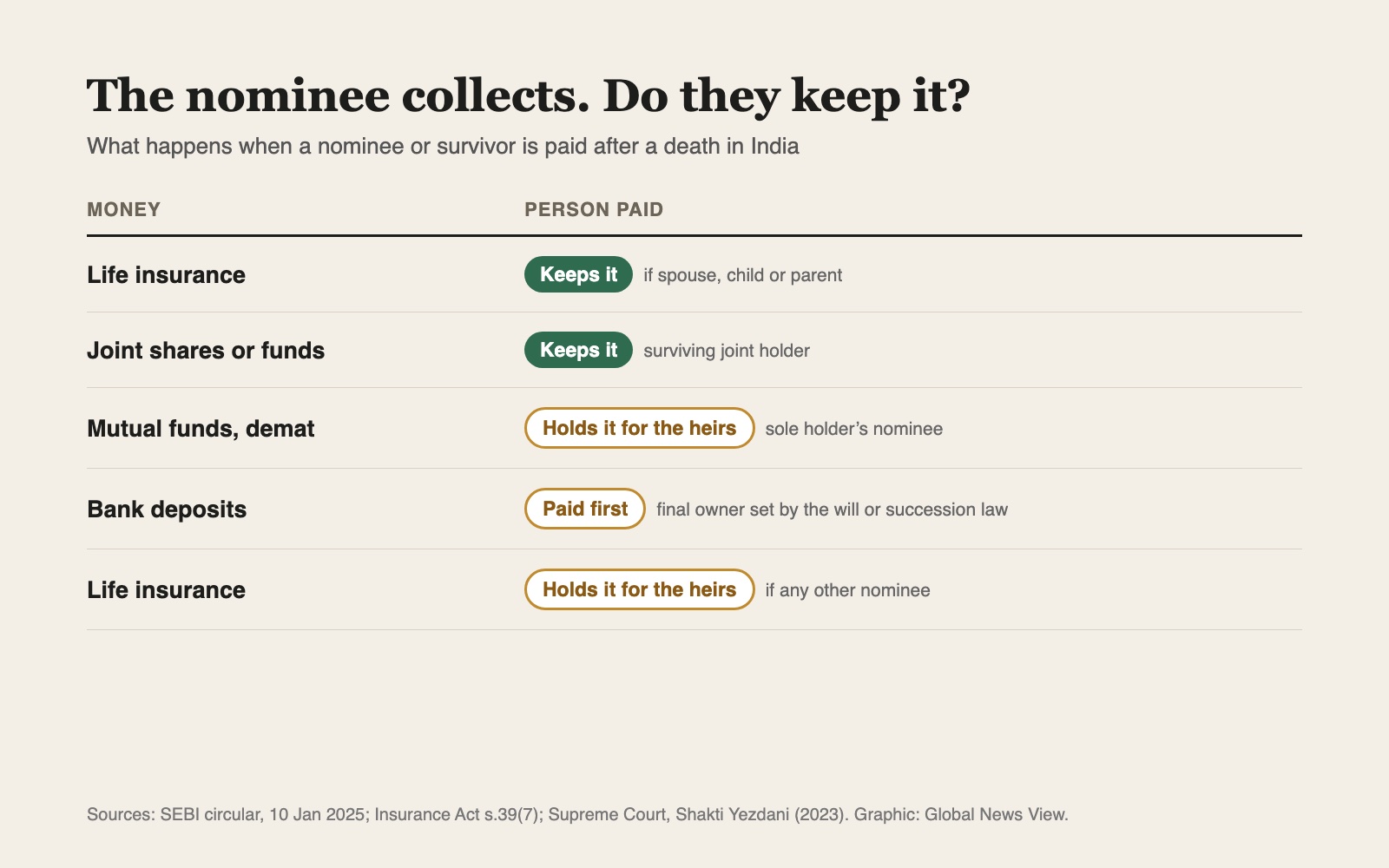
What happens to each kind of money
Savings accounts and fixed deposits
The rules changed in 2025. The Reserve Bank’s Settlement of Claims in respect of Deceased Customers of Banks Directions, issued on 26 September 2025 and to be in place at every bank by 31 March 2026, fixed the paperwork and the deadlines.
If there is a nominee, or the account is joint with an “either or survivor” style clause, the bank needs three things: a claim form, the death certificate and the nominee’s identity proof. It cannot ask for a succession certificate or a probated will. It has to settle within 15 calendar days of getting complete documents. If it is late for reasons of its own, it owes interest at the Bank Rate plus 4% a year for the delay.
If there is no nominee, the family uses a simplified route for smaller amounts: up to ₹15 lakh at commercial banks and ₹5 lakh at co-operative banks. That needs a claim form, the death certificate, an indemnity bond, a no-objection from the other legal heirs and proof of heirship, and the bank cannot demand a third-party surety. Above those limits, expect to be asked for a succession certificate or probate, which means court.
A bank’s job ends when it pays the right person. Who that money finally belongs to is decided separately, by the will or by succession law. You can now name up to four nominees on a bank account, under the Banking Laws (Amendment) Act, 2025, which makes it easier to match the nomination to what you actually intend.
Bank lockers
Lockers follow the same split. With a nominee, the bank must allow access without insisting on a succession certificate or probate. The contents are inventoried before they are handed over, and the bank has 15 days to process the claim. Delay beyond that costs the bank ₹5,000 for every day, payable to the claimant.
Mutual funds and shares
Since 1 March 2025, an investor can nominate up to 10 people on a demat account or mutual fund folio. The nominee gets the units or shares transferred on a death certificate, the standard form and their own KYC, but as a trustee for the legal heirs, as above.
One detail in the SEBI circular catches families out. If the nominee dies before the investor, the nominee’s own heirs have no claim. The nomination simply falls away, and the units pass under the investor’s will or succession law. It is a good reason to check nominations after any death in the family, not just your own.
Life insurance
A term or life policy pays the nominee once the claim is admitted. If the nominee is the spouse, a child or a parent, the money is theirs outright under section 39(7). If the nominee is anyone else, a sibling, say, or a friend, they receive it but hold it for the legal heirs.
Death claims are also where insurers say no most painfully, often over alleged non-disclosure. If that happens, the route through the insurer, Bima Bharosa and the Insurance Ombudsman is the same as for any other claim, and our guide to appealing a rejected insurance claim sets out the deadlines, including the three-year limit after which an insurer can no longer question a life policy on any ground.
Provident fund
For salaried people the largest single sum is often the EPF balance, along with the EPS family pension and the EDLI death benefit of up to ₹7 lakh that comes with it. Each pays the nominee or, failing that, the family under EPFO’s own rules. How those three fit together, and why the death benefit so often goes unclaimed, is covered in our guide to EPF, EPS and EDLI.
A worked example: one family, three different outcomes
The difference between collecting and owning is easiest to see with numbers. Take a Hindu man who dies without a will. He leaves his wife, two children and his mother. He had ₹12 lakh in a savings account with his wife as nominee, ₹8 lakh in mutual funds with his brother as nominee, and a ₹1 crore term policy with his wife as nominee.
Without a will, his estate goes to his Class I heirs under the Hindu Succession Act. Section 10 gives the widow one share and each son, daughter and the mother one share each. Here that is four equal shares: wife, two children, mother. His brother is not a Class I heir.
| Asset | Paid first to | Who it belongs to | Each heir’s share |
|---|---|---|---|
| Savings account, ₹12 lakh | Wife (nominee), within 15 days | The four Class I heirs equally | ₹3 lakh each |
| Mutual funds, ₹8 lakh | Brother (nominee), as trustee | The four Class I heirs equally | ₹2 lakh each |
| Term insurance, ₹1 crore | Wife (nominee) | Wife alone, as beneficial nominee | Wife ₹1 crore; others nil |
Illustration on stated assumptions, not a real case: Hindu male, no will, Class I heirs are widow, two children and mother (Hindu Succession Act s.10). Shares are amount ÷ 4. Mutual fund nominee as trustee per SEBI circular of 10 January 2025, para 2.4; insurance per Insurance Act s.39(7). Ignores debts, which come out of the estate first (see below).
Add it up and the wife ends up with ₹1.05 crore (₹3 lakh + ₹2 lakh + ₹1 crore), while each child and the mother get ₹5 lakh. The brother, who physically received ₹8 lakh, ends up with nothing and is legally obliged to pass it on. In real families this is where things go wrong: the person who received the money assumes it is theirs, and nobody explains otherwise until there is a dispute.
A will changes the right-hand columns, not the left. The banks and the fund house would still pay the same nominees; the will decides who they are holding it for.
What happens to loans and credit card dues
Debts don’t vanish, but they don’t jump onto the family either. Lenders are paid out of the estate, before anyone inherits. Under section 50(2) of the Code of Civil Procedure, a legal representative is liable for the deceased’s debts only up to the value of the property that comes into their hands. A child who inherits ₹5 lakh can’t be made to pay a ₹10 lakh credit card bill out of their own salary.
Tax: nothing on inheriting, one return to file
India abolished estate duty in 1985 and has had no inheritance tax since. Money or property received under a will or by inheritance isn’t taxed as income in the hands of the person who receives it. What they earn on it afterwards, the interest on an inherited fixed deposit for example, is taxed as their own income in the normal way.
The deceased person’s own taxes still need closing. Their legal representative becomes responsible for any tax due and has to file the final return for the year of death. To do it, they register on the income tax e-filing portal as legal heir, with the deceased’s PAN, the death certificate and a legal heir document. The department says it processes these requests within seven days.
When nobody knows the account exists
All of this assumes the family knows what was there. Often it doesn’t. A savings account opened for a salary job twenty years ago, a small policy bought from a relative, a folio from a fund house that has since merged: when no one claims them, the money eventually moves to regulator-run funds, where it waits indefinitely. Searching for it is a separate job, and our guide to finding unclaimed money in India goes through the four portals that hold it.
What to set up while everyone is well
- Check every nomination, then check it again. Bank accounts, fixed deposits, demat, each mutual fund folio, EPF and every insurance policy each have their own. Many people have one old nomination on a closed account and none on the accounts that matter.
- Pick the nominee for what they will do, not as a gesture. On insurance, a spouse, child or parent keeps the money. Anywhere else, the nominee is a trustee, so choose someone who will hand it over as the will or the law says.
- Write a will and tell someone where it is. Nominations decide who collects. The will decides who keeps. Without one, succession law decides, and as the example above shows, that may not match what the nominations suggest.
Frequently asked
- Does the nominee become the owner of the money?
- Usually not. For mutual funds and demat accounts, SEBI’s January 2025 circular says a sole holder’s nominee receives the assets as trustee for the legal heirs, and the Supreme Court held in 2023 that nomination does not override succession law. The exceptions are surviving joint holders of securities, who take as owners, and life insurance nominees who are the policyholder’s spouse, child or parent.
- How long does a bank take to settle a deceased person’s account?
- Under RBI’s 2025 directions for deceased customers, banks must settle deposit claims within 15 calendar days of receiving complete documents, and pay interest at the Bank Rate plus 4% a year for delay attributable to the bank.
- What if there is no nominee on the bank account?
- For claims up to ₹15 lakh at commercial banks (₹5 lakh at co-operative banks), banks use a simplified procedure: claim form, death certificate, indemnity bond, a no-objection from other legal heirs and proof of heirship, with no third-party surety. Above that, a succession certificate or probate is usually needed.
- Do family members have to pay a deceased person’s loans?
- Not from their own money. Under section 50(2) of the Code of Civil Procedure, legal representatives are liable only up to the value of the estate that reaches them. Co-borrowers and guarantors are liable in their own right.
- Is there inheritance tax in India?
- No. Estate duty was abolished in 1985, and money or property received by inheritance or under a will is not taxed as income. Income earned on it afterwards is taxed normally.