If you are reading this, there is probably a letter or an email open in another tab that says your claim has been “repudiated”. The word does a lot of work. It sounds final, and it is written to sound final. It isn’t. In India a rejected claim has a set escalation path with deadlines on both sides, and at its end sits a body, the Insurance Ombudsman, whose decision binds the insurer, costs you nothing, and does not need a lawyer.
What follows goes through it in the order you will actually meet it: the rejection letter, the complaint you write back, and then the two places you can go when that complaint gets nowhere. Bima Bharosa, IRDAI’s grievance portal, comes into it too, though not quite in the way most people expect.
First, read the rejection letter like a lawyer would
Don’t reply to it yet. Read it for one thing: the exact reason, and the policy clause it points to. IRDAI requires insurers to give reasons “with specific reference to the relevant terms and conditions” when they turn down a complaint, and the health insurance rules say the same about a repudiation. If your letter says something vague like “not payable as per policy terms” and names no clause, that vagueness is itself the first point of your appeal.
Most rejections fall into a handful of buckets, and each one has a different answer:
- Non-disclosure of a pre-existing disease. The strongest counter is time. For health policies, IRDAI’s 2024 circular sets a moratorium: once you have 60 months of continuous cover, the insurer can’t contest the policy on non-disclosure any more, except for established fraud. For life policies, Section 45 of the Insurance Act does something similar after three years from the date of the policy. Count your years carefully, including portability and renewals.
- Waiting period. Check the dates against the schedule in your policy, not the brochure. If you ported the policy from another insurer, the waiting periods you had already served, including for pre-existing disease, carry across under IRDAI’s portability rules; if the letter ignores that, say so.
- “Documents not submitted” or “claim intimated late”. For life insurance, the master circular is blunt: “No claim shall be rejected or closed for want of documents or for delayed intimation of claim”. For health claims, the 2024 health circular puts the paperwork on the insurer and its TPA, who are meant to collect the documents from the hospital themselves; it says the policyholder “shall not be required to submit the documents”.
- Hospitalisation “not required” or treatment “could have been OPD”. This one is usually fought on medical records. Ask your treating doctor for a short note on why admission was necessary. It carries more weight than anything you write yourself.
- Exclusion clauses. Read the exclusion word for word. Insurers sometimes apply an exclusion that covers something next to your condition, not the condition itself.
One more thing to check on a health claim. Under the 2024 health circular, no claim can be repudiated without the approval of the insurer’s Product Management Committee or its Claims Review Committee. You are entitled to ask whether that happened in your case.
The complaint you write back to the insurer
Everything later depends on this step, and not just because it might work. The Ombudsman will not take your case unless you have first complained to the insurer in writing, by email or through the insurer’s website (rule 14(3) of the Insurance Ombudsman Rules, 2017). A phone call to customer care does not count. So write it properly, send it to the grievance officer (every insurer lists one on its website), and keep the acknowledgement.
It doesn’t need to be long. A version I’d be comfortable sending looks like this, with the brackets filled in:
To: The Grievance Redressal Officer, [Insurer name]
Subject: Complaint against repudiation of claim no. [number], policy no. [number]
I am writing about your letter dated [date], which rejects my claim for [hospitalisation from date to date / death of the life assured on date / the loss on date] on the ground that [quote their reason exactly].
I dispute this decision because [one or two sentences per reason, e.g. “the condition was first diagnosed on [date], after the policy began, as the enclosed report shows”, or “the policy has been continuously in force since [date], more than 60 months ago”].
Your letter does not identify [the policy clause relied on / any document that was asked for and not supplied]. Please reconsider the claim and send me your decision with reasons, with reference to the specific terms of the policy, as IRDAI’s rules require.
Enclosed: rejection letter, policy schedule, [discharge summary, doctor’s note, bills, reports].
[Name, phone, email, date]
Keep it factual. Quote their words back to them, attach evidence, and ask for reasons. Anger doesn’t help here, and the same letter will be read later by the Ombudsman.
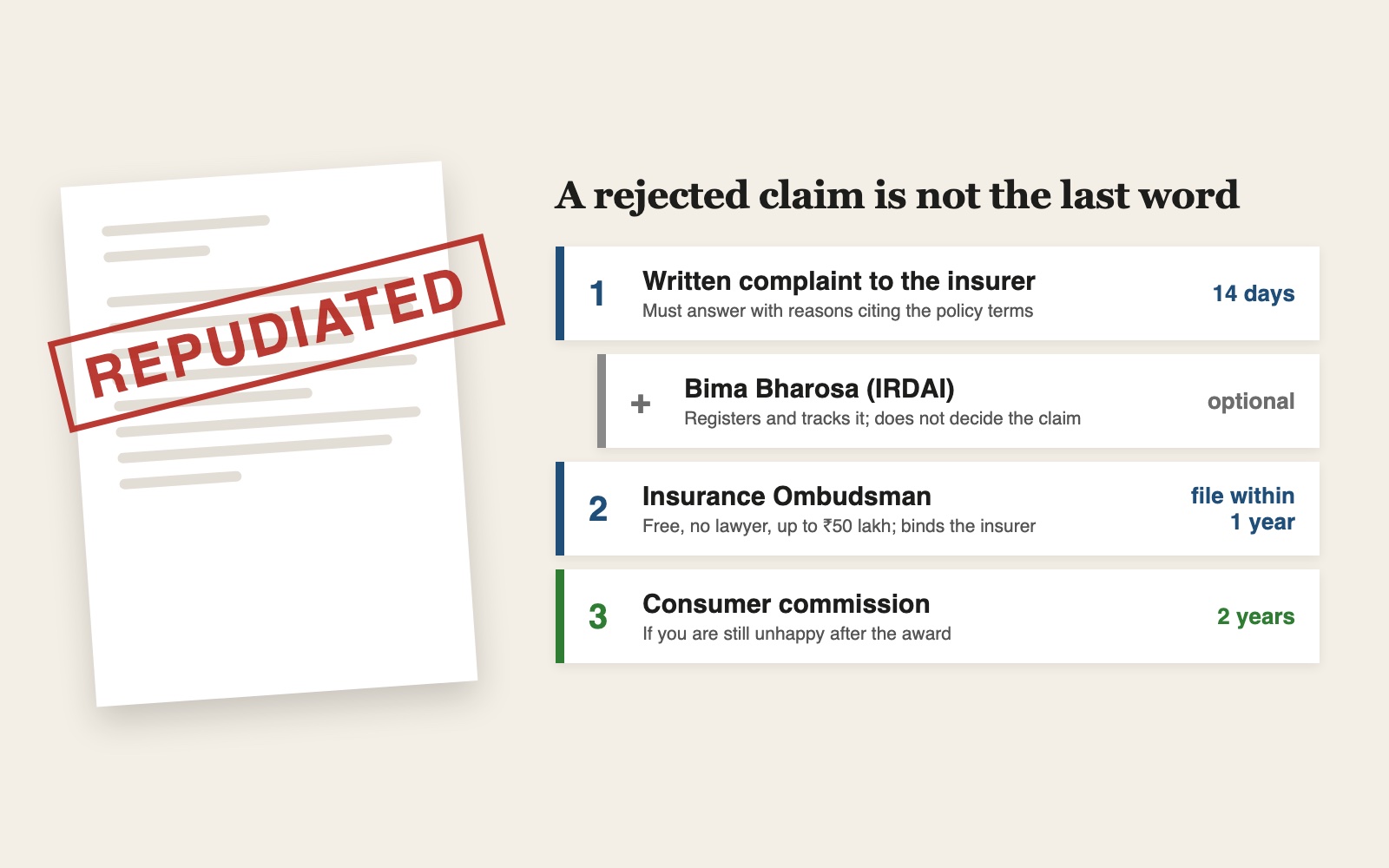
IRDAI’s 2024 circular says the insurer must acknowledge the complaint immediately and resolve it within 14 days, giving reasons if it isn’t accepting it. (Both of the popular guides I checked this against say 15 days; the current circular says 14.) If you want a record outside the insurer’s own system, this is the point to use Bima Bharosa.
What Bima Bharosa does, and what it doesn’t
Bima Bharosa (bimabharosa.irdai.gov.in) is IRDAI’s grievance management system. You can register a complaint there against any insurer, or email complaints@irdai.gov.in, or call the IRDAI grievance call centre on 155255 or 1800 4254 732. The complaint is sent to the insurer, it gets a reference number, and you can track it.
Here’s the catch people discover late: Bima Bharosa doesn’t decide your claim. It is a monitoring and routing system. The insurer still answers the complaint, and IRDAI watches how insurers handle complaints as a whole. That is useful pressure (a complaint with the regulator watching tends to get looked at by someone more senior) but it is not an appeal. If the insurer says no again, the next step is still the Ombudsman.
So use it, but don’t sit and wait on it for months. The Ombudsman clock in the next section runs anyway.
The deadlines, all in one place
| Step | Time limit | Where the rule comes from |
|---|---|---|
| Insurer acknowledges your written complaint | Immediately | IRDAI master circular on policyholders’ interests, 2024 |
| Insurer resolves your complaint, with reasons citing policy terms | 14 days | Same circular |
| You can go to the Ombudsman | Once the insurer rejects the complaint, you are unhappy with its reply, or a month passes with no reply | Insurance Ombudsman Rules 2017, rule 14(3)(a) |
| Last date to file with the Ombudsman | One year from the insurer’s final reply (or from the end of that month of silence) | Rule 14(3)(b); the Ombudsman can condone delay under rule 14(4) |
| Ombudsman’s recommendation, if both sides agree to mediate | One month from both sides’ written consent | Rule 16(1) |
| Ombudsman’s award | Three months from receiving everything needed from you | Rule 17(4) |
| Insurer pays under the award | 30 days, or ₹5,000 a day payable to you after that | Rule 17(6); IRDAI master circular, 2024 |
| Consumer commission complaint | Two years from when the cause of action arose | Consumer Protection Act 2019, section 69 |
Rules as in force on 29 September 2026. A draft amendment to the Ombudsman Rules published in November 2025 would change parts of this, including an appeal route against awards; it had not been finalised when this guide was written.
Taking it to the Insurance Ombudsman
Ombudsman offices sit in cities across the country under the Council for Insurance Ombudsmen, which lists on cioins.co.in which office covers which area. You can file online there, by email, by post, or in person. There is no fee. The Council’s own FAQ says the rules have “no provision to engage a lawyer”, so this is designed for you to argue yourself.
A few conditions decide whether your case is admitted:
- The amount. The Council’s FAQ puts the ceiling at compensation of up to ₹50 lakh, and IRDAI’s 2024 circular uses the same figure. Above that, go to a consumer commission or a civil court.
- You must have complained to the insurer first, in writing, and either been refused, been unhappy with the answer, or heard nothing for a month.
- You are within a year. Miss it and you are relying on the Ombudsman agreeing to condone the delay, which is discretionary.
- The same dispute is not already before a court, a consumer commission or an arbitrator.
What to send: the complaint form, a copy of your letter to the insurer and its reply (or proof that you sent it and got nothing), the policy, the rejection letter, and the medical or loss documents behind the claim. The hearing is short. Both sides get to speak, sometimes by video. If the insurer offers a settlement and you accept it in writing within 15 days, the Ombudsman records it as a recommendation. If not, you get a written award with reasons.
The award is binding on the insurer. It has 30 days to pay, and if it doesn’t, IRDAI’s circular makes it liable to pay you ₹5,000 for every day of delay, on top of interest under the Ombudsman Rules. You aren’t bound the same way. If you lose, or win less than you think you should, you can still go to a consumer commission or court.
When the Ombudsman isn’t the right place
For large claims, or where you want compensation for harassment and costs on top of the claim itself, a consumer commission is the usual route. People get caught out here. The time limit is two years from when the cause of action arose, not from whenever you finish with the Ombudsman, so a long detour can eat into it. And the commission you file in is set by the value paid as consideration for the service: up to ₹50 lakh at the district commission, ₹50 lakh to ₹2 crore at the state commission, and above that at the national commission, under the 2021 jurisdiction rules. For most retail policies that means the district commission. A lawyer isn’t required there either, though many people use one.
If you’re in the hospital right now
Rejections that happen at the cashless desk feel different because the bill is due today. IRDAI’s health circular gives insurers one hour to decide a cashless request and three hours to authorise the final discharge once the hospital sends it. Any extra amount the hospital charges because of a delay beyond that has to be borne by the insurer, from its own funds.
A cashless denial is not a claim rejection. If cashless is refused, you can pay, keep every original bill and report, and file a reimbursement claim. Ask the TPA desk for the denial in writing before you leave. It becomes the first document in everything above.
Claims on a life policy after a death
Families usually meet this process at the worst possible time, so a few specifics are worth knowing. IRDAI’s 2024 circular requires death claims to be settled within 15 days of intimation, or 45 days where investigation is warranted, and late settlement carries interest at two percentage points above the bank rate. A claim can’t be rejected just because papers are missing or the death was reported late. And after three years from the date of the policy, Section 45 of the Insurance Act stops the insurer from questioning the policy on any ground at all. If a letter cites non-disclosure on an older policy, check that date first.
The escalation route is the same: a written complaint to the insurer, Bima Bharosa if you want the regulator in the loop, then the Ombudsman. Nominees and legal heirs can file.
Before you give up on it
IRDAI’s own annual report for 2024-25 put health claims repudiated at about 8% of the 3.26 crore claims insurers handled that year, according to coverage of the report. Plenty of those were legitimate rejections under the policy terms. Not all of them were, and the only way to find out which kind yours is is to push it through the steps above, in writing, keeping copies. The system is slow in places, but it is free and it is written down. Insurers know the timelines. It helps a lot when you know them too.
Frequently asked
- How long does an insurer have to reply to a complaint about a rejected claim?
- Under IRDAI’s 2024 master circular on policyholders’ interests, the insurer must acknowledge the complaint immediately and resolve it within 14 days, giving reasons with reference to the specific policy terms if it does not accept it.
- When can I go to the Insurance Ombudsman?
- After you have complained to the insurer in writing, email or through its website, and it has rejected the complaint, given a reply you are not satisfied with, or not replied within one month. You must file within one year of that point, under rule 14(3) of the Insurance Ombudsman Rules, 2017.
- Does the Insurance Ombudsman charge a fee, and do I need a lawyer?
- There is no fee. The Council for Insurance Ombudsmen says the rules make no provision for engaging a lawyer, so complainants present their own case. Complaints up to ₹50 lakh can be heard.
- Is the Ombudsman’s decision binding?
- It binds the insurer, which must comply within 30 days of receiving the award; IRDAI’s circular makes a late insurer pay the complainant ₹5,000 a day. It does not bind you: if you are unhappy you can still go to a consumer commission or court.
- Can Bima Bharosa overturn a rejected claim?
- No. Bima Bharosa is IRDAI’s grievance management system. It registers your complaint, sends it to the insurer and tracks it, and lets IRDAI monitor complaint handling. The insurer still decides; the binding decision comes from the Ombudsman or a court.
- Can I go to the consumer court and the Ombudsman at the same time?
- No. Rule 14(5) of the Ombudsman Rules bars a complaint on a matter already pending before, or decided by, a court, consumer forum or arbitrator. Going to the Ombudsman first keeps the consumer commission open, within its two-year limit.