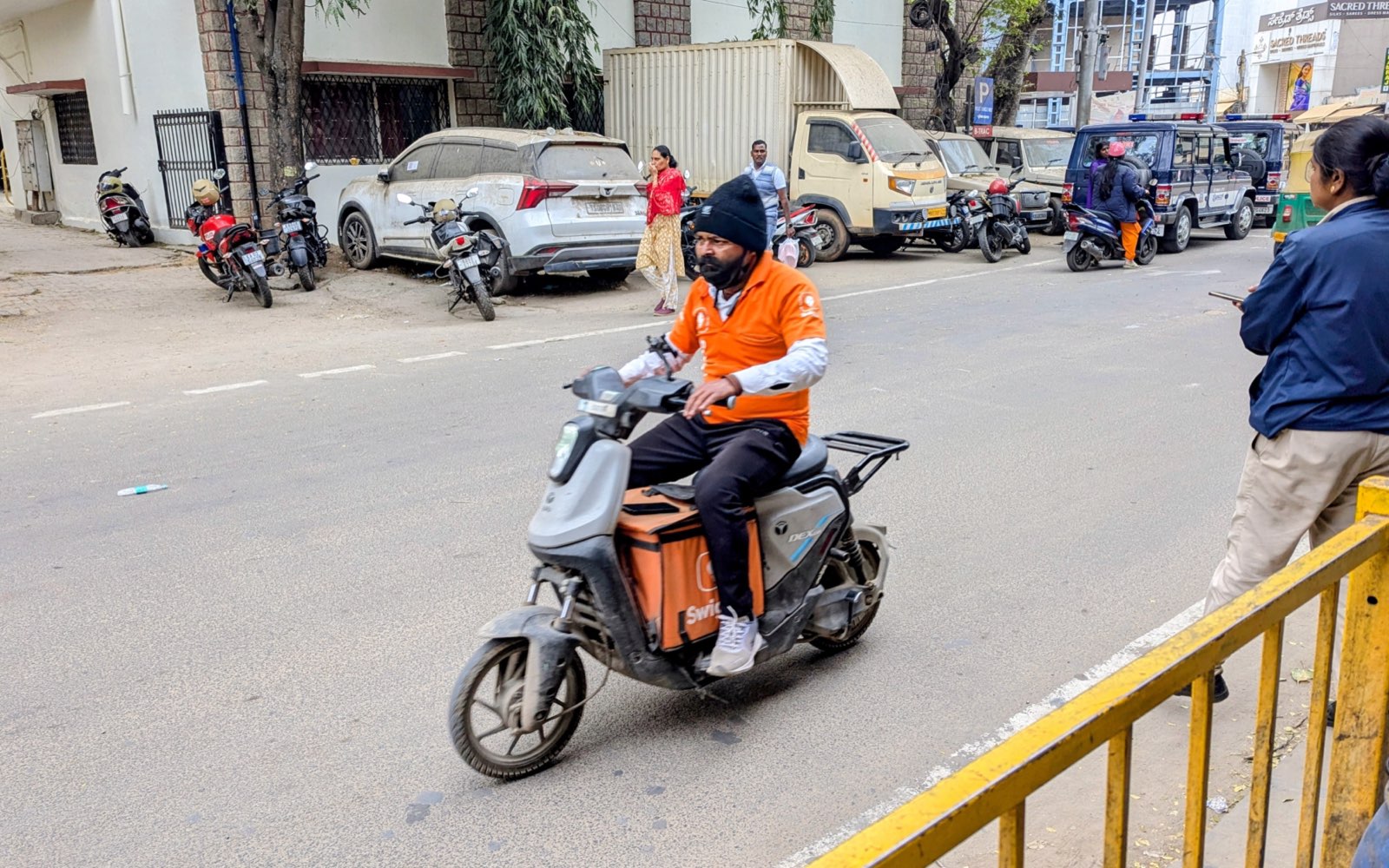
On 20 July 2026 a member of the Lok Sabha, P C Mohan, put a narrow question to the Labour Ministry. What is the current status of the formulation and notification of welfare schemes for gig and platform workers under section 114 of the Code on Social Security, and when will the Ayushman Bharat cover announced in the 2025-26 Budget be rolled out? A later limb of the same question asked whether cities with a large platform workforce, Bengaluru among them, would be given priority given the contributions collected there.
The written statement laid in the House ran to three pages. It explained what section 114 provides for. It described the Social Security Fund, the contribution band of 1 to 2% of aggregator turnover and the National Social Security Board. It reported that 21 aggregators had come onto the e-Shram portal, that a registration module for platform workers had been live since March 2025, and that over 10.65 lakh platform workers were registered as on 14 July 2026. Its final paragraph said the Ministry had held multiple rounds of deliberations with aggregators, knowledge partners, worker associations and state governments in order to move forward for a comprehensive welfare scheme.
It named no scheme, because there is not one yet.
That is the gap this guide is about. Since 21 November 2025 a gig worker in India has a legal definition, a chapter of a statute and a welfare fund that exists on paper. What a gig worker does not have is a notified scheme to claim from. Recognition and entitlement get reported as if they were the same event. They are about a year and a notification apart.
Only one of the four codes has your name in it
All four labour codes came into force on the same day. Only one of them mentions you. The Code on Social Security, 2020 defines a gig worker at section 2(35) as a person who performs work or participates in a work arrangement and earns from such activities outside of a traditional employer-employee relationship, and a platform worker at section 2(61) as a person engaged in or undertaking platform work. The Labour Ministry confirmed to Parliament that these definitions appear in that Code for the first time in Indian law.
Everything turns on one phrase: outside of a traditional employer-employee relationship. It is why Chapter IX had to be written at all. It is also why the other three codes do not reach you.
Take the Code on Wages, 2019, which is where a minimum wage would come from. Section 2(k) defines an employee as a person employed on wages by an establishment to do skilled, semi-skilled or unskilled work “for hire or reward”. Section 2(z) defines a worker in almost the same terms. A minimum rate of wages is owed to employees. If your legal description begins by placing you outside an employment relationship, the obligation does not attach.
There is a door in that clause. Section 2(k) ends by including “a person declared to be an employee by the appropriate Government”. The Centre or a state could bring gig workers inside the Code on Wages by notification, without amending a word of it. Neither has.
| Code | Names gig or platform workers? | What it carries for people it covers |
|---|---|---|
| Code on Wages, 2019 | No | Minimum and floor wages, a fixed wage period, limits on deductions |
| Industrial Relations Code, 2020 | No | Recognised negotiating unions, conciliation, notice and compensation on retrenchment |
| Occupational Safety, Health and Working Conditions Code, 2020 | No | Daily and weekly hour limits, safety duties, a free annual health check |
| Code on Social Security, 2020 | Yes — ss. 2(35), 2(61) and Chapter IX | Registration, a Social Security Fund, and schemes once they are framed |
The Industrial Relations and OSH Codes do not define gig or platform work. Writing in the Oxford Human Rights Hub in March 2026, advocate Aayushi Swaroop reads that silence as excluding these workers from collective bargaining and from the Code that regulates hours, health checks and safety standards.
For salaried staff the codes mostly rearranged what was already owed, which is why the visible effect there was on the shape of a payslip rather than on whether protection existed at all. We worked that through in our guide to CTC under the labour codes. For gig workers the codes did something different and more basic. They created a category that had no legal existence, and then left the contents of it to be filled in later.
What section 114 promises, and the verb it hangs on
Section 114(1) is the operative provision. The Central Government may frame and notify suitable social security schemes for gig workers and platform workers on matters relating to life and disability cover, accident insurance, health and maternity benefits, old age protection, crèche facilities, and any other benefit it specifies.
Every list of gig worker benefits you will read is a paraphrase of that sentence. The list is real. So is the word “may”. Nothing in the section obliges the government to frame any of them, or sets a date by which it must.
The funding architecture sits in the subsections that follow. Under 114(3) a scheme may be funded wholly by the Centre, jointly with a state, wholly out of aggregator contributions, or by some combination of Centre, state, beneficiaries and aggregators, and may draw on corporate social responsibility spending. Under 114(4), aggregators in the categories listed in the Seventh Schedule pay a rate notified by the Centre of between 1% and 2% of annual turnover, and that contribution cannot exceed 5% of the amounts they pay or owe to gig and platform workers. Under 114(5) the Centre notifies the date from which those contributions begin.
The National Social Security Board for Unorganised Workers and Gig and Platform Workers was notified on 30 October 2026. It is chaired by the Union Labour Minister, includes representatives of aggregators, worker associations, state governments and civil society, and must meet at least three times a year. Reading its functions as the Ministry published them is instructive. The first is to recommend to the Central Government the framing of suitable schemes. The others are to advise, to monitor schemes the Centre administers, to review state-level record keeping, and to review expenditure from the fund. The Board is a body that recommends spending. It does not create an entitlement, and it was constituted eleven months after the Code took effect.
Registration is the gate, and most people are not through it
Section 113 requires every unorganised, gig and platform worker to register. You must have completed 16 years of age, file a self-declaration in the prescribed form, and apply with an Aadhaar number, against which a distinguishable number is issued. The portal must also allow you to register yourself rather than wait for a platform to do it.
The sub-section that matters most is the one that reads like boilerplate: a worker registered under section 113 is eligible to avail the benefit of the relevant scheme. Registration is not itself a benefit. It is the precondition for every benefit the chapter can ever deliver, which makes the registration numbers a fair measure of how far the law has travelled.
Registration figures: Lok Sabha replies of 1 December 2025 and 20 July 2026, and the Labour Ministry's e-Shram five-year factsheet of 25 August 2026. The workforce estimate of over one crore traces to NITI Aayog's 2022 report, which put the gig workforce at 77 lakh in 2020-21 and projected 2.35 crore by 2029-30, and which cautions that its own figure is indicative rather than a count.
Roughly one gig worker in nine is registered, and that is measuring against a projection the authors themselves hedged. Three nationwide registration drives ran through 2025. Twenty-one aggregators, including Zomato, Blinkit, Swiggy, Ola, Uber, Rapido, Amazon, Porter, Urban Company and Flipkart, are now connected to the portal and share worker details through an API. The number still moved by less than a lakh between July and August 2026.
There is also a condition on e-Shram that catches people by surprise. The Ministry’s own factsheet states that a worker registering must not be an income-tax payer, nor a member of the EPFO or the ESIC. A rider or driver whose income is below the threshold is unaffected. A freelancer or a consultant taking platform work who files a return is, on the face of that condition, outside the database that Chapter IX runs on. If you are in that position it is worth reading how side income is taxed in India alongside this, because the two systems draw the line in different places.
The 90-day test that decides whether any of it reaches you
Registering is the first filter. Qualifying is the second. Under the Social Security (Central) Rules, 2026, notified on 8 May 2026, a worker becomes eligible for benefits by putting in at least 90 days with a single aggregator, or 120 days in total across several, during the previous financial year. The days need not run consecutively, and eligibility has to be earned again each year.
Two details in that test decide who passes it. A day counts only if you earned something from the platform that day, so logging in and waiting for an order does not count. And the threshold rises when you work across apps: 90 days buys eligibility on one platform, while someone splitting the same effort between Swiggy and Zepto needs 120. Multi-apping is the normal way the work is done, and the rule charges 30 extra days for it. Reporting in Forbes India in May 2026 recorded lawyers and staffing-industry figures warning that the test would fall hardest on seasonal workers, on women returning from a maternity break, and on anyone whose account is deactivated part-way through a year. The same reporting notes that eligibility stops at 60.
A caution on this section. We could not read the notified rule text itself; the thresholds above are as reported by Forbes India and by policy analysts summarising the Rules, and they are consistent across those accounts. Check the gazette text before relying on the exact day counts in a dispute.
Where the aggregators’ money is, and is not
The 2026 Rules put real obligations on platforms. Aggregators must register on the Shram Suvidha portal, upload the workers already engaged with them within 45 days, and after that report joiners and leavers through the API rather than by hand. There is a contribution calendar, with a self-assessment form due in June and a final return later in the year, and interest on late payment.
What has not been issued is the notification under section 114(4) that fixes the rate inside the 1% to 2% band, or the notification under 114(5) that says when contributions start. Until both exist, the Social Security Fund has a legal basis, a governing board and no income from aggregators.
So the data obligations are live and the money obligations are not. Platforms are already handing over worker records; the fund those records are supposed to pay into is empty. That sequence is not an accident of drafting. Registration is cheap and contributions are not, and the cheap half went first.
Karnataka collected the money, and the High Court is holding it
One state did issue the notification the Centre has not. The Karnataka Platform Based Gig Workers (Social Security and Welfare) Act, 2025 allows a welfare fee of between 1% and 5% on payouts to gig workers. Karnataka constituted its welfare board on 27 January 2026, chaired by the Labour Minister with seats for worker unions and for aggregators including Porter, Zomato, Uber and Amazon, and notified the fee the following month at the bottom of the band. The Labour Minister, Santosh Lad, told Deccan Herald in January that stakeholders had suggested 1 to 1.5% and that the rate could be raised later. Karnataka App-based Workers’ Union president Inayat Ali said the union had asked for 2 to 5% and called the figure very little.
The notified fee is 1% of each payout, subject to a cap per transaction: 50 paise for a two-wheeler ride or a two-wheeler food or grocery delivery, 75 paise for a three-wheeler, one rupee for a four-wheeler, and ₹1.50 for a heavy vehicle or a professional services job. The caps, rather than the percentage, are what decide the size of the fund.
| Per order | Per month | Per year | |
|---|---|---|---|
| Orders completed | 1 | 520 | 6,240 |
| Paid to the rider, at ₹35 an order | ₹35 | ₹18,200 | ₹2,18,400 |
| Welfare fee at 1%, below the cap | ₹0.35 | ₹182 | ₹2,184 |
| Welfare fee if every order reached the 50 paise cap | ₹0.50 | ₹260 | ₹3,120 |
| For comparison: the central ceiling of 5% of payouts | ₹1.75 | ₹910 | ₹10,920 |
Illustration, our arithmetic, at Karnataka's notified rate of 1% with a 50 paise cap per two-wheeler delivery, effective 13 February 2026. We assume 20 orders a day across 26 days at a ₹35 payout; the cap starts to bite once a single payout reaches ₹50. Order volumes and per-order payouts vary widely between cities and platforms. The last row is not a rate anyone has notified. Section 114(4) caps a central contribution at 5% of payments to workers, and it is set out here only to show the size of the band the Centre is choosing within.
A year of full-time riding generates somewhere around ₹2,200 to ₹3,100 for the welfare fund. Measured against what the government already sells to unorganised workers, that is not a trivial sum. The accident cover under PMSBY costs ₹20 a year and the life cover under PMJJBY ₹436, so ₹2,200 would buy both several times over. Measured against a pension, sick pay, or income while an injury heals, it is not close. The fee as notified can insure a rider. It cannot replace a rider’s earnings.
None of it has been spent. The Internet and Mobile Association of India, with Eternal, Swiggy, Zepto, Urban Company and others, challenged the Karnataka Act as repugnant to the central Code under Article 254. On 3 July 2026 Justice M Nagaprasanna declined to stay the Act, directed the platforms to deposit the fee with the High Court registry within three weeks instead of paying it to the state, and barred coercive action meanwhile. The Additional Solicitor General appeared and supported the platforms, arguing the state law could not operate in the teeth of the central Code. The platforms argued, among other things, that no welfare scheme had been framed to disburse the money.
In October 2026 gig worker unions in Karnataka asked the state welfare board to meet and adopt schemes, saying statutory benefits had yet to reach them. So the one jurisdiction that has actually collected contributions has them sitting in a court registry, while the central government argues in that same court that the collection is invalid, and has notified no rate of its own. We could not verify what has happened in the case since August 2026, and the constitutional challenge was still pending at that point.
What you can claim today
Nothing above means there is nothing to do. It means the things worth doing come from being an unorganised worker, which you already were, rather than from Chapter IX, which has not started paying.
Registration on e-Shram is free, takes an Aadhaar number and a mobile number, and can be done at register.eshram.gov.in or at a Common Service Centre. It produces a 12-digit Universal Account Number. The Ministry’s One-Stop Solution then connects that number to 15 welfare schemes, and the ones that matter most to someone on a two-wheeler are specific and cheap:
- Pradhan Mantri Suraksha Bima Yojana. ₹2 lakh for accidental death or permanent disability, ₹1 lakh for partial disability. This is the cover that fits the actual risk of the job.
- Pradhan Mantri Jeevan Jyoti Bima Yojana. ₹2 lakh of life cover, for death from any cause.
- Pradhan Mantri Shram Yogi Maan-Dhan. A minimum assured pension of ₹3,000 a month from the age of 60, subject to the scheme’s own conditions, with contributions during your working life.
- Ayushman Bharat PM-JAY. The 2025-26 Budget announced health cover for platform workers through e-Shram registration and identity cards. Over 15 crore e-Shram registrants were linked to PM-JAY as of November 2025, though that figure covers unorganised workers generally, not gig workers as a class.
What the codes have not given you is also worth being clear about, because it shapes what to ask for. There is no minimum wage, no guaranteed rate per order or per kilometre, and no standing to raise an industrial dispute. On deactivation, the central rules set no notice period and no appeal. Karnataka’s Act requires 14 days’ notice before most terminations and Rajasthan’s allows a complaint to its welfare board, which is a large part of why the state laws are being defended so hard by unions and fought so hard by platforms.
What would show the position has changed
Three things, none of which requires new legislation.
A notification under section 114(4) and 114(5) fixing the contribution rate and the date it starts. That is the one that turns the Social Security Fund from an account into an income. Until it is issued, every other development is preparatory.
The first scheme notified under section 114(1), and whether it is a new benefit or a rebadging of PMSBY, PMJJBY and PM-JAY, which gig workers can already join. A scheme that mostly points at cover already available would close the political question without closing the protection gap.
The Karnataka judgment on Article 254. If the state law survives, gig workers in Karnataka, Rajasthan, Jharkhand and Telangana get a route that does not depend on the Centre moving. If it does not, the money in the registry goes back and the central notification becomes the only route there is.
Legal recognition was the part that cost nothing, and it has been delivered in full. The schemes are the part that costs money, and a year in, the strongest official statement available on them is that deliberations are continuing.
Frequently asked
- Are gig workers entitled to minimum wages under the labour codes?
- No. Minimum wages come from the Code on Wages, 2019, which owes them to an “employee” — defined in section 2(k) as a person employed on wages by an establishment for hire or reward. The Code on Social Security defines gig work as falling outside a traditional employer-employee relationship, so the obligation does not attach. Section 2(k) does let the appropriate Government declare any person to be an employee by notification, which would bring gig workers in. No such notification has been issued.
- What benefits does section 114 of the Code on Social Security promise gig workers?
- Section 114(1) lets the Central Government frame schemes covering life and disability cover, accident insurance, health and maternity benefits, old age protection and crèche facilities. The verb is “may”. As of the Labour Minister’s reply to the Lok Sabha on 20 July 2026, no scheme had been notified under it; the Ministry described continuing deliberations towards a comprehensive welfare scheme.
- How do I register as a gig worker, and what does it cost?
- Registration is on the e-Shram portal at register.eshram.gov.in, or at a Common Service Centre, and it is free. You need an Aadhaar number for eKYC and a mobile number, and you must have completed 16 years of age. You get a 12-digit Universal Account Number. The Labour Ministry’s factsheet also states that a registrant must not be an income-tax payer or a member of the EPFO or ESIC.
- How many gig workers are registered on e-Shram?
- Around 11.5 lakh platform workers as of the Ministry’s e-Shram five-year factsheet in August 2026, up from 10.65 lakh on 14 July 2026 and 5.09 lakh in November 2025. The government works from a NITI Aayog-based estimate of more than one crore gig workers in 2024-25, rising to 2.35 crore by 2029-30, so roughly one in nine is registered.
- How many days do I need to work to qualify for gig worker benefits?
- As reported from the Social Security (Central) Rules, 2026, at least 90 days with a single aggregator or 120 days across several, in the previous financial year. The days need not be consecutive, but a day counts only if you earned from the platform that day, so waiting while logged in does not count. Eligibility has to be earned again each year and is reported to stop at age 60. We could not read the notified rule text directly, so verify the day counts in the gazette before relying on them.
- Are aggregators paying into the gig workers’ fund yet?
- Not centrally. Section 114(4) sets a band of 1 to 2% of annual turnover, capped at 5% of payments to gig and platform workers, but the rate has not been notified and section 114(5) leaves the start date to a further notification that has not been issued. Karnataka notified its own 1% welfare fee from 13 February 2026, and platforms have been depositing it with the Karnataka High Court while they challenge the state Act.
- What happens if a platform deactivates my account?
- The central rules set no notice period and no appeal. Two state laws go further: Karnataka’s Act requires 14 days’ notice before most terminations, and Rajasthan’s lets a worker complain to its welfare board. Deactivation also carries a second cost, because days not worked count against the 90 and 120-day eligibility thresholds for the following year.