330 rockets tried to reach orbit in 2025. Five of them were Indian. That ratio is a useful way into this year’s World Space Week, which runs from 4 to 10 October under the theme “Rocket revolution”, a nod to how cheap, frequent and reusable launches have changed who gets to space and how often.
The UN, which recognises the week, says more than 50,000 events are planned in over 100 countries. For India, the more pointed question is where it sits in that revolution, and when it will join the three countries that have put people into orbit on their own rockets.
Who launched the 330
Source: Wikipedia, 2025 in spaceflight, tally by country of the rocket's origin (not the launch provider or spaceport). Also one each for Australia, Germany, Iran and Israel. World total 330, of which 317 succeeded. India's five included one failure.
The United States accounted for 60% of all attempts (198 of 330) and China for 28%. India’s five were 1.5%. The pattern hasn’t changed this year: of 236 orbital launches counted so far in 2026, the US has 140 and China 70. India has three, one of which failed.
One rocket, half the world’s launches
The “revolution” in the theme is mostly one machine. SpaceX’s Falcon 9 flew 165 times in 2025, exactly half of every orbital launch on Earth. On 157 of those flights the first stage had flown before. Reuse is what turned a launch from a national event into something closer to an airline schedule, and the much larger Starship is the next step in the same bet.
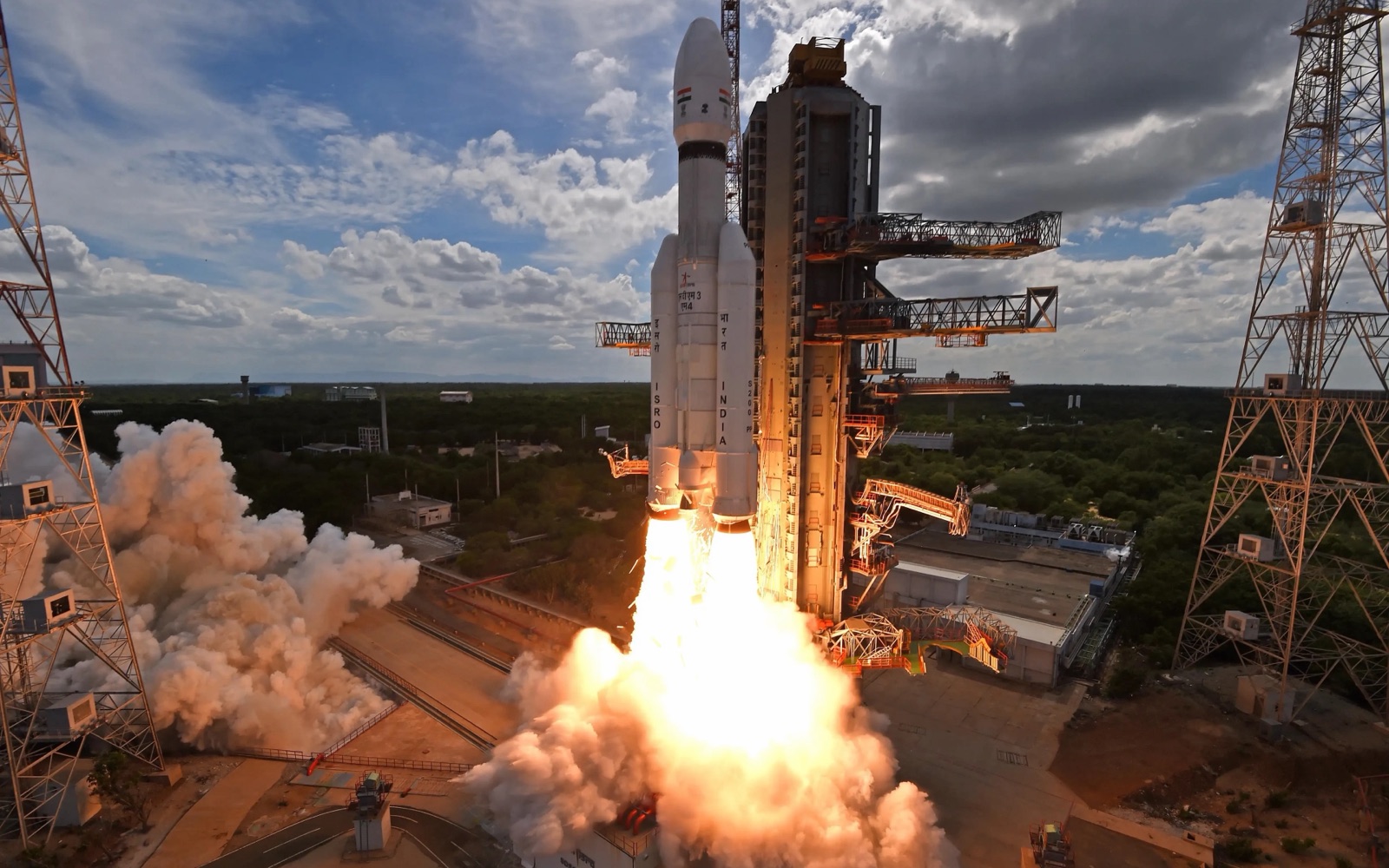
Put plainly, a single American rocket model flew 33 times as often as all of India’s rockets combined last year (165 ÷ 5). None of ISRO’s operational launchers is reusable yet.
The club India is trying to join
According to Al Jazeera, 746 people from at least 52 countries have been to space, 112 of them women. But only three countries have launched their own citizens on their own rockets: the Soviet Union, from Yuri Gagarin in April 1961; the United States; and China, from 2003.
Indians have flown before, but on other countries’ vehicles. Rakesh Sharma went up on a Soviet Soyuz in 1984. Last year Group Captain Shubhanshu Shukla flew to the International Space Station on the private Axiom-4 mission, launching on 25 June 2025 and returning on 15 July. Gaganyaan is meant to make India the fourth country with its own crew capability.
How 2022 became 2027
The programme’s dates have moved repeatedly. Laid side by side, the official targets tell their own story.
| When it was said | Who | First crewed flight | First uncrewed flight (G1) |
|---|---|---|---|
| 15 August 2018 | Prime Minister, Independence Day speech | By 2022 | ( |
| December 2022 | Reported by the Times of India | Fourth quarter of 2024 | ) |
| May 2025 | Minister Jitendra Singh | First quarter of 2027 | Later in 2025 |
| 23 October 2025 | ISRO chairman V Narayanan | ( | December 2025 |
| 3 December 2025 | Jitendra Singh, to Parliament | First quarter of 2027 | ) |
| 21 January 2026 | Press Information Bureau | : | Likely second half of 2026 |
| 4 September 2026 | V Narayanan, after the EOS-05 launch | 2027, after three uncrewed flights | Late 2026 |
Sources: Hindustan Times (2018); Times of India (2022); DD News (May 2025); All India Radio (October 2025); Swarajya (December 2025); PIB (January 2026); Starlust (September 2026). A dash means no target was given in that statement.
The crewed date has held at “2027” for more than a year, but the uncrewed flight that has to come first has slipped from December 2025 to the second half of 2026 and now to late 2026. It has not flown. Narayanan said on 4 September that around 8,000 tests have been completed and that the safety of the crew comes first. That is the stated reason the dates keep moving.
What has to happen before an Indian crew flies
ISRO’s own sequence is three uncrewed orbital flights, the first carrying the half-humanoid robot Vyommitra, each reviewed before the next. If G1 launches in late 2026, a crewed flight within 2027 needs the other two uncrewed missions to fly and succeed in roughly a year, on a human-rated version of the LVM3 rocket. That is possible, but it leaves little room for the kind of slip the table above shows has been normal.
The date to watch is G1’s. Until it flies, every crewed target is a plan rather than a schedule. When it does, India will have done the hardest part of what it is celebrating this week: putting a spacecraft built for people into orbit and bringing it home.