
“For years, the Biden administration overcharged you to fund the operation of HealthCare.gov.” That line, from a letter signed by President Donald Trump and quoted by CNBC, is now arriving in the mailboxes of more than 950,000 Americans with a $500 Treasury payment attached. The Trump administration began sending the checks on Wednesday, 30 September.
The payments are real and nobody has to apply for them. The claim behind them is harder to check, because the White House has not said how big the “surplus” is or how it arrived at $500. What can be checked is the fee it says was too high, and the government’s own rulemaking on that fee tells a more complicated story.
Who gets a check
According to the White House fact sheet of 10 September, the refund goes to people who bought a plan through the federal exchange, HealthCare.gov, and “do not receive premium assistance”, meaning they paid the full premium with no premium tax credit. It is $500 per person, so a household with more than one affected member can receive more than one payment. The fact sheet does not name a plan year; coverage of the announcement describes the qualifying coverage as 2026 plans.
In practice that is mostly people earning more than 400% of the federal poverty level, about $63,000 a year for a single adult per CNBC, who lost subsidy eligibility when the enhanced premium tax credits expired at the end of 2025. It also covers some lower earners who simply didn’t take the subsidy.
The fact sheet lists the 30 eligible states: Alabama, Alaska, Arizona, Arkansas, Delaware, Florida, Hawaii, Indiana, Iowa, Kansas, Louisiana, Michigan, Mississippi, Missouri, Montana, Nebraska, New Hampshire, North Carolina, North Dakota, Ohio, Oklahoma, Oregon, South Carolina, South Dakota, Tennessee, Texas, Utah, West Virginia, Wisconsin and Wyoming.
Why New Jersey and the other 19 states are out
Everyone else buys coverage through a state-run marketplace: Get Covered New Jersey, Covered California, NY State of Health, Pennie in Pennsylvania and so on, plus DC Health Link. Those exchanges run their own platforms and fund them themselves, so insurers there never paid the HealthCare.gov fee the refund is based on. The result is that two people paying full price for similar plans get different treatment depending only on which exchange their state uses. A full-price buyer in New Jersey gets nothing; one in Delaware gets $500.
What the “overcharge” refers to
Insurers selling on HealthCare.gov pay the federal government a user fee, set as a percentage of every monthly premium. It funds the running of the exchange: the website, the call centre, eligibility checks, outreach. The White House says the rate was set higher than the exchange needed, that insurers passed it on to customers through premiums, and that the extra money built up as a surplus. Its reasoning for refunding only full-price buyers is that they “paid the full cost”, while subsidised enrollees had much of their premium covered by tax credits.
The rate for 2026 is 2.5%. It was finalised in January 2025, in the last weeks of the Biden administration, with a lower 2.2% that would have applied only if Congress had extended the enhanced premium tax credits by 31 July 2025. It didn’t, so 2.5% stood.
CMS proposed to keep the same rate for 2027
Here is the part the coverage has mostly missed. In February 2026, the Trump administration’s own Centers for Medicare & Medicaid Services proposed a 2027 user fee of 2.5%, “the same as the 2.5 percent FFE user fee rate finalized for 2026,” citing a reduced budget, falling enrollment and higher premiums. Only in the final rule, published in May, did it cut the rate to 1.9%, saying it had revised its projections “based on newly available data”.
| Plan year | Rate | Set by | When |
|---|---|---|---|
| 2026 | 2.5% | HHS payment notice for 2026 (2.2% only if subsidies had been extended) | Finalised January 2025 |
| 2027, as proposed | 2.5% | HHS payment notice for 2027, proposed rule | February 2026 |
| 2027, as finalised | 1.9% | HHS payment notice for 2027, final rule | May 2026 |
Sources: CMS fact sheet on the 2026 payment notice; Federal Register, 11 February 2026 and 20 May 2026. Oregon runs its marketplace on the federal platform, where the equivalent rate was 2.0% for 2026 and is 1.5% for 2027.
None of this proves or disproves that a surplus exists. User fee income depends on how many people enrol and what premiums turn out to be, and both moved sharply in 2026. But it does show that the rate now described as an overcharge was one the current administration was prepared to charge again, until its own numbers changed.
Is $500 more or less than the fee a full-price buyer paid?
Because the fee is a flat percentage, it is easy to work out what it comes to on any premium. At 2.5%, the whole fee on a plan costing $6,000 a year is $150. On $12,000 it is $300. The fee only reaches $500 on a premium of $20,000 a year for one person.
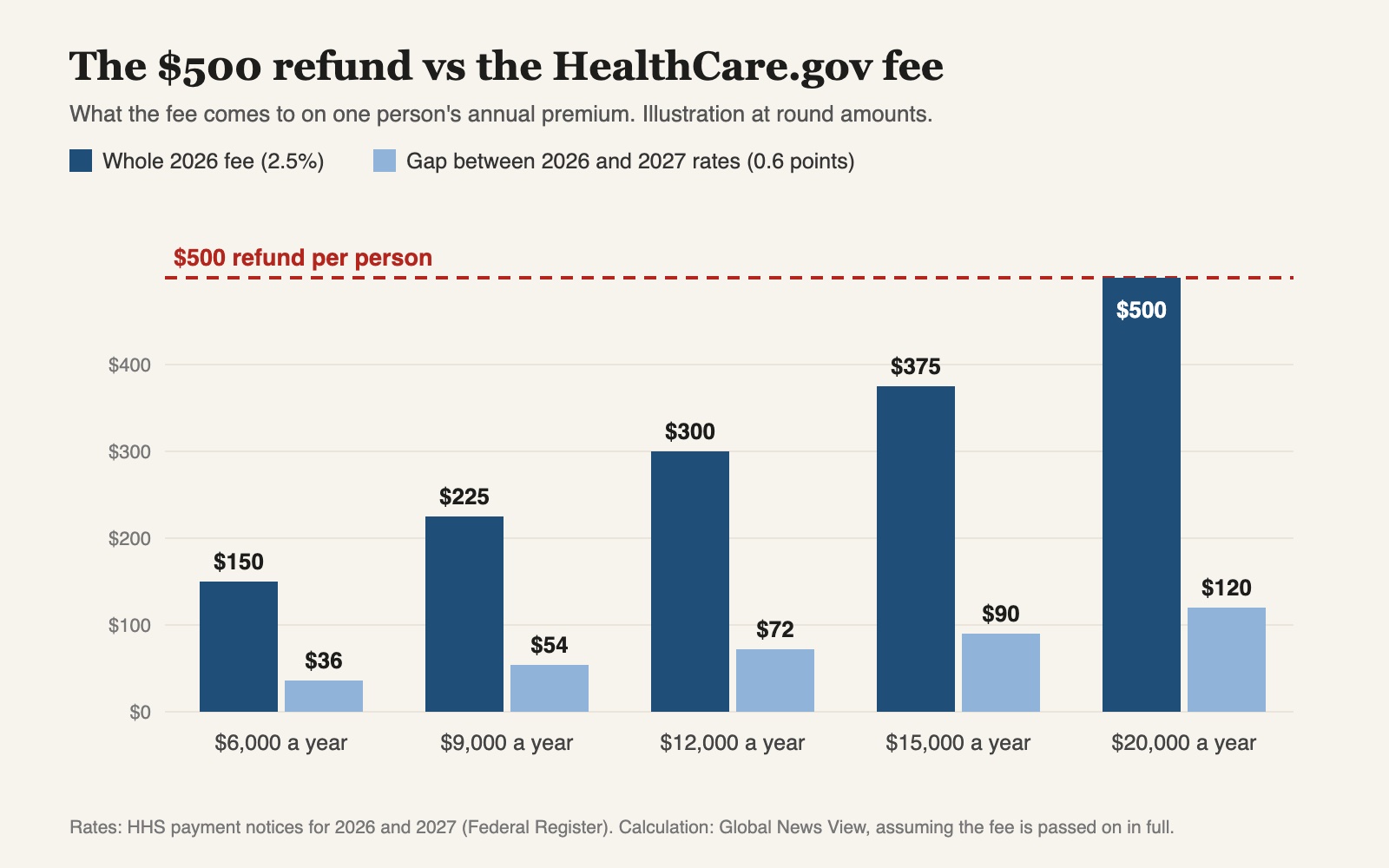
The refund, in other words, is larger than the entire user fee for most individual policies, not just the portion that might have been excess. If you treat the gap between the 2026 rate and the 2027 rate (0.6 of a percentage point) as the overcharge, the amount on a $12,000 premium is $72.
So the $500 is better understood as a flat payment funded from fee money than as a refund of what each person was charged. That isn’t unusual for a one-off rebate, but it matters for anyone trying to square the letter’s wording with their own premium. For a family of three full-price buyers, it is $1,500, which is real money after premiums in HealthCare.gov states rose about 30% on average this year, according to KFF’s estimate of what insurers are charging.
The total also puts the scale in context. At $500 each, 950,000 payments come to about $475 million, our multiplication. The White House describes the amount only as “hundreds of millions”.
Questions the fact sheet leaves open
- How big is the surplus? No figure has been published, and neither has the legal authority for paying it out to individuals rather than, say, lowering future fees.
- Is the payment taxable? The fact sheet doesn’t say. Anyone who deducts health insurance premiums, such as the self-employed, may want to check with a tax adviser before filing.
- What about part-year subsidies? People who received a premium tax credit for only some months of 2026 aren’t addressed in the fact sheet.
- What if no check arrives? There is no application process. HealthCare.gov enrollees who think they qualify and receive nothing have no published route to claim it.
The payments are going out just over a month before the 3 November midterm elections. Expect the checks to keep arriving through October, and the argument about whether they are a refund or a campaign mailer to last longer than that.
Frequently asked
- Who qualifies for the $500 ACA refund?
- People who bought a plan through HealthCare.gov in one of the 30 states that use the federal exchange and did not receive a premium tax credit, according to the White House fact sheet of 10 September 2026. It is $500 per person, so a household can receive more than one payment.
- Do I need to apply for the $500 Obamacare refund?
- No. Payments are sent automatically by check or direct deposit, with Treasury mailing starting on 30 September 2026. There is no published claim process for people who think they qualify and receive nothing.
- Why are New Jersey, California and New York excluded?
- They run their own state marketplaces rather than HealthCare.gov. The refund is funded from the federal exchange user fee, which insurers in state-run exchanges do not pay.
- What is the ACA user fee?
- A charge on insurers selling through the federal exchange, set as a percentage of each monthly premium to fund the exchange. It was 2.5% for 2026. CMS proposed keeping 2.5% for 2027 in February 2026, then finalised 1.9% in May 2026.