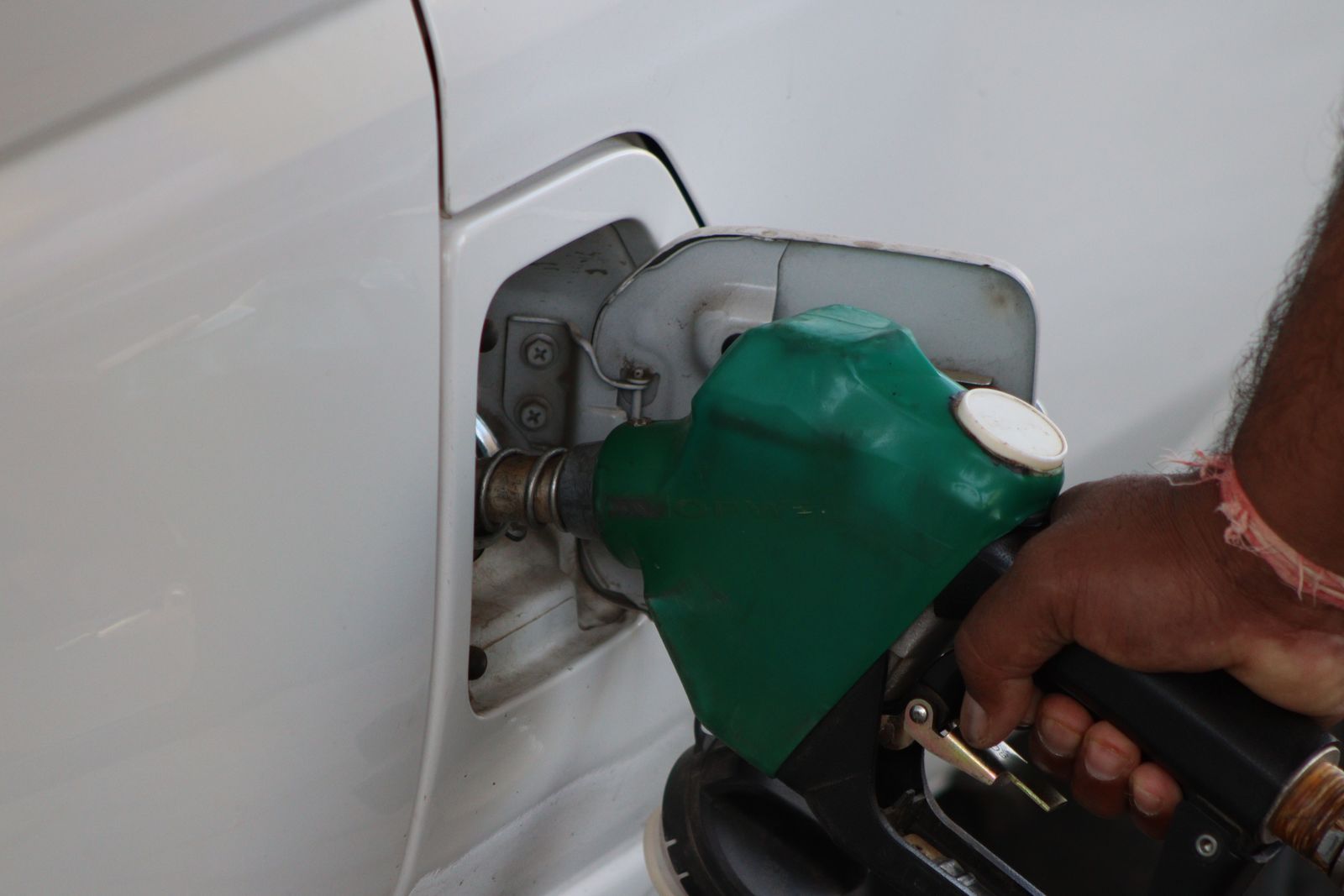
Fuel blending in India has quietly become universal. Every litre of ordinary petrol now contains a fifth ethanol, compressed biogas is being phased into the CNG network from this financial year, and the Road Transport Minister has floated blending up to 15 per cent isobutanol into diesel. Whether that has made your commute more expensive is a question with an actual answer, and it is not the one either side of the argument usually gives.
Three mandates, three different chemistries
The most common error in coverage of this subject is treating all three as one phenomenon. They are not, and the difference decides whether you should expect a mileage effect at all.
| Fuel | What is blended in | Chemically |
|---|---|---|
| Petrol | Ethanol, 20% | A different molecule. Lower energy per litre than petrol, higher octane |
| Diesel | Isobutanol, up to 15% (proposed) | A different molecule again, but higher energy density than ethanol |
| CNG | Compressed bio-gas, 3–5% | Purified to automotive grade — essentially the same gas as CNG |
The bio-CNG description follows the technical point made on the Team-BHP forum thread supplied with this brief, and is consistent with how compressed biogas is produced: the raw gas is purified, de-acidified and compressed until it meets automotive specification.
This is not like ethanol blended petrol where another substance of differing properties is being mixed into the fuel.
Shreyans_Jain, Team-BHP forum, 7 August 2026
That observation, made by a long-standing member of the forum thread in this brief, is the single most useful thing anyone has said about this subject. Methane from a purified biogas plant and methane from a gas field are the same molecule. Ethanol and petrol are not. So the physics gives you a clear prior: expect a measurable efficiency effect from E20, expect very little from bio-CNG, and expect something in between from isobutanol.
He adds a practical caveat worth keeping in view: “The purification and compression equipment of biogas costs many times more than the basic biogas plant itself.” The chemistry is easy; the economics of getting there are not.
What is mandated, and from when
| Programme | Level | Status and timing |
|---|---|---|
| Ethanol in petrol (E20) | 20% | Rolled out nationwide. All grades except 100-octane are E20 |
| Bio-CNG in CNG and PNG | 3% in FY 2026–27 | Notified blending obligation on city gas distributors |
| Bio-CNG — step up | 4% in FY 2027–28, 5% from FY 2028–29 | Under the GOBARdhan scheme |
| Isobutanol in diesel | Up to 15% | Proposal stage. Announced by Nitin Gadkari, July 2026 |
The GOBARdhan National Unified Scheme for Compressed Biogas was approved by the Union Cabinet on Thursday, 6 August 2026 with an outlay of ₹23,731 crore, running to FY 2035–36. Note that the CBG obligation covers household piped gas as well as vehicle CNG.
On diesel, it is worth being precise about how early this is. Nitin Gadkari said “ethanol can’t be blended directly in diesel, so we’re producing isobutanol from ethanol”, and cited pilot work: “We’ve successfully run two generator sets on 100% ethanol and isobutanol. This proves engines can be built to operate on these fuels.” Two generator sets is a demonstration, and “can be built” describes new engines rather than the diesel vehicles already on Indian roads. Nothing in that statement speaks to what 15 per cent isobutanol does in a ten-year-old truck.
The government’s case, in its own numbers
The official position is detailed and deserves stating properly rather than as a strawman. The Ministry of Petroleum and Natural Gas published a point-by-point response to mileage concerns, and its argument is that the programme was never primarily about your fuel bill.
| Claim | Figure or basis |
|---|---|
| Foreign exchange saved, ESY 2014–15 to July 2025 | ₹1,44,087 crore |
| Crude oil substituted | About 245 lakh metric tonnes |
| CO₂ reduction claimed | 736 lakh metric tonnes — “equivalent of planting 30 crore trees” |
| Payment to farmers at 20% blending, this year | About ₹40,000 crore |
| Forex saving at 20% blending, this year | About ₹43,000 crore |
| Lifecycle emissions vs petrol (NITI Aayog) | 65% lower for sugarcane ethanol, 50% for maize |
| Octane | Ethanol ~108.5 vs petrol 84.4; regular petrol RON raised to 95 |
| Efficiency drop in E10-era vehicles | “Marginal”; some vehicles E20-compatible since 2009 |
From the Ministry of Petroleum and Natural Gas response published by PIB on 12 August 2025. The ministry also states E20 gives better acceleration and ride quality, cites Brazil running E27 “with zero issues”, and says only certain older vehicles may need rubber parts and gaskets replaced earlier — once in a vehicle’s lifetime, at routine service.
The ministry’s position on mileage specifically is that critiques of a “drastic” reduction are misplaced, because fuel economy depends on driving habits, servicing, tyre pressure and air-conditioning load as well as fuel. That is true as far as it goes. It is also the standard difficulty with any claim of this kind: those same confounders were present before the blend changed.
Petroleum Minister Hardeep Singh Puri put the number at “just up to 3 per cent, which is negligible”. The Automotive Research Association of India has estimated a 1 to 6 per cent dip.
What drivers actually report
The gap between the official figure and owner-reported experience is the whole controversy, and it is large.
| Finding | Proportion |
|---|---|
| Owners of 2023–24 petrol vehicles reporting >10% mileage drop since early 2025 | Nearly 59% |
| Owners reporting a drop exceeding 20% | 25% |
| Pre-2023 vehicle owners reporting >10% drop, May 2026 | 45% |
| Pre-2023 vehicle owners reporting >10% drop, June 2026 | 66% |
| Owners reporting unusual wear, tear or repairs, May → June 2026 | 29% → 55% |
Survey of more than 22,000 vehicle owners. These are self-reported figures, not instrumented measurements — see the caveat below.
The arithmetic that decides your fuel bill
Here is the question that actually matters, and it is the one a reader of this site raised: if mileage falls, you simply buy more fuel to cover the same distance — so does the whole thing wash out?
The instinct is right and the conclusion is understated. It does not wash out. It costs you more, for a reason that is easy to miss.
| Mileage drop | New km/l | Litres per year | Extra fuel | Extra cost |
|---|---|---|---|---|
| None (baseline) | 15.00 | 800.0 | — | — |
| 3% (official estimate) | 14.55 | 824.7 | +3.09% | ₹2,474 |
| 5% | 14.25 | 842.1 | +5.26% | ₹4,211 |
| 10% (survey majority) | 13.50 | 888.9 | +11.11% | ₹8,889 |
| 20% (survey quarter) | 12.00 | 1,000.0 | +25.00% | ₹20,000 |
Our own calculation. Assumptions, stated so you can substitute your own: baseline 15 km/l, 12,000 km driven a year, petrol at ₹100 per litre. Litres per year = 12,000 ÷ km/l. Extra cost = additional litres × price. Change any of the three and the percentages hold while the rupee figures scale.
Same assumptions as the table. At a 20% mileage loss you buy an extra 200 litres a year to travel exactly as far as before.
Why E20 is not cheaper — and why the government does not claim it should be
This is where the reader’s hypothesis gets its answer. If blended petrol carries less energy per litre, the logically consistent outcome would be a lower pump price, leaving cost per kilometre roughly unchanged. That is not what happens. E20 is sold at the same price as the petrol it replaced.
The Ministry’s explanation is straightforward and, to its credit, does not pretend otherwise: ethanol is not currently cheaper to procure. Maize-based ethanol has been bought at around ₹71.86 per litre before GST, transport, storage and depot handling. On the ministry’s own account, blending “is not designed to lower petrol prices on a given day”. It is designed to replace imported crude with a domestic input whose price does not move with Brent.
| Benefit | Accrues to |
|---|---|
| Foreign exchange saved on crude imports | The national balance of payments |
| ₹40,000 crore to ethanol suppliers and farmers | The rural economy |
| Insulation from global oil price shocks | All consumers, indirectly and over time |
| Lower lifecycle CO₂ | Everyone, eventually |
| Any mileage loss | The individual driver, immediately |
This table is an analytical summary of the two sides’ own stated positions, not a claim by either. The asymmetry it describes — diffuse national benefit, concentrated individual cost — is the honest shape of the disagreement.
So the reader’s instinct holds, with one correction. The cost does not stay the same. If there is a genuine efficiency loss and the price has not fallen to reflect the lower energy content, the driver absorbs the entire difference. The government’s answer is not that this is untrue — it is that the benefit is national rather than personal, and shows up in the import bill rather than at the pump.
Whether that trade is worth it is a political judgement, not a technical one. But it should be made with the arithmetic visible, and the arithmetic is above.
The market has cast a vote of its own
There is one number that summarises consumer sentiment better than any survey. The Maruti WagonR BioFlex, India’s first mass-market flex-fuel passenger car, capable of running on blends from E20 to E100 and homologated for E85, launched on 4 June 2026 with deliveries from 17 June. In its first weeks it recorded three registrations.
It carries a premium of roughly ₹74,000 over the equivalent top-spec petrol variant, at ₹7.24 lakh ex-showroom. In fairness, industry commentary attributes the figure largely to the absence of E85 pumps rather than to hostility toward the technology — a chicken-and-egg problem in which retailers will not build dispensing infrastructure without vehicles, and buyers will not buy vehicles without fuel. Both readings can be true. Neither is an encouraging signal for voluntary adoption.
What could not be verified
Final Verdict
Three things are true about fuel blending in India at once, and most commentary picks one and stops.
The government’s macro case is real and largely uncontested on its own terms: ₹1.44 lakh crore of foreign exchange conserved, 245 lakh tonnes of crude substituted, and a genuine transfer of money that used to leave the country toward domestic agriculture. You can dispute the emissions accounting or the sugarcane water footprint, but the import substitution is arithmetic.
The driver’s complaint is also real, and the government’s own framing concedes the shape of it. If your mileage has genuinely fallen and the pump price has not, you are paying for a national benefit out of your own tank, on a schedule nobody asked you about. At a 10 per cent loss that is roughly ₹8,900 a year on the assumptions above; at 3 per cent it is under ₹2,500, which is closer to noise than to a grievance.
And the three fuels should stop being discussed as one. Bio-CNG is purified to be substantially the same gas that is already in the pipeline, and there is little physical reason to expect it to behave differently. Ethanol genuinely carries less energy per litre. Isobutanol in diesel is not yet a consumer product at all. Lumping them together produces the worst of both errors — unwarranted alarm about bio-CNG, and unwarranted complacency about the one blend that has actually changed what comes out of every pump in the country.
The practical advice is narrow but useful. Measure your own mileage across three consecutive full tanks before concluding anything, because a single tank tells you about traffic rather than fuel. Check tyre pressure and service history first, since both move economy by more than 3 per cent on their own. And do not pay a premium for higher-octane grades in the belief that you are buying less ethanol, because with the single exception of 100-octane, you are not.
Frequently asked
- Does E20 petrol really reduce mileage?
- Ethanol carries less energy per litre than petrol, so some reduction is expected physics rather than a defect. The dispute is over size. Petroleum Minister Hardeep Singh Puri has said the loss is “up to 3 per cent, which is negligible” and ARAI estimates 1 to 6 per cent. A LocalCircles survey of more than 22,000 owners found nearly 59 per cent reporting drops above 10 per cent, and independent real-world tests have put losses at 8 to 12 per cent in older cars.
- If my mileage drops 20 per cent, do I burn 20 per cent more fuel?
- No — you burn 25 per cent more. A mileage drop of X raises consumption by 1 ÷ (1 − X) − 1, because you are dividing a fixed distance by a smaller number. A 10 per cent drop means 11.1 per cent more fuel, and a 20 per cent drop means 25 per cent more. This is the calculation most people get backwards.
- Is E20 petrol cheaper than unblended petrol?
- No. The Ministry of Petroleum and Natural Gas says blending “is not designed to lower petrol prices on a given day”, noting that maize-based ethanol has been procured at around ₹71.86 per litre before GST and handling — as much as or more than the petrol it replaces. The stated benefit is energy security and rural income rather than a lower pump price, which means any genuine mileage loss is absorbed by the driver.
- Do premium petrol grades contain less ethanol?
- No. All petrol grades except 100-octane are now E20, including HPCL Power 95, Indian Oil XP95 and XP99, BPCL Speed 97 and Shell V-Power. Premium grades differ in their additive package for deposit and corrosion control, not in ethanol content.
- Will bio-CNG blending reduce my CNG car’s mileage?
- There is no published measurement either way. Unlike ethanol, compressed biogas is purified, de-acidified and compressed until it is essentially the same gas as CNG, so there is little physical reason to expect a difference. Officials say no vehicle changes are needed and performance should be unchanged. Blending is 3 per cent in FY 2026-27, rising to 4 per cent and then 5 per cent from FY 2028-29, and covers household piped gas as well as vehicle CNG.
- What is isobutanol blending in diesel?
- A proposal, not a rollout. Road Transport Minister Nitin Gadkari said in July 2026 that the government is working towards allowing up to 15 per cent isobutanol in diesel, because ethanol cannot be blended into diesel directly. The cited pilot evidence is two generator sets run on 100 per cent ethanol and isobutanol, which demonstrates that engines can be built for these fuels rather than that existing diesel vehicles will run unaffected on a 15 per cent blend.