National Voter Registration Day 2026 falls on Tuesday, 15 September, and for the fourteenth year running thousands of organisations will spend it signing people up at libraries, campuses, food banks and community centres across the United States. The campaign has a straightforward record behind it: more than six million Americans registered through it since 2012, around 1.5 million in the single day in 2020 alone, and more than 2,000 community partners signed up for this year’s effort, with partners in every state.
But the most useful thing an already-registered American can do today is not register. It is to check that the registration they think they have still exists — because the number of records removed from the rolls between federal elections now runs into eight figures, and the legal framework that used to constrain how those removals happen was substantially narrowed five months ago.
What the day actually is
National Voter Registration Day is a non-partisan civic holiday, held on the third Tuesday of September each year. It is not a government programme and it does not change any law or deadline. It is a coordination exercise: a single date on which a large number of independent organisations run registration drives simultaneously, so that the effort is visible enough to reach people who would not otherwise think about it until it is too late.
| Measure | Figure |
|---|---|
| Date in 2026 | Tuesday, 15 September |
| Years running | 14 |
| Americans registered since 2012 | 6 million+ |
| Registered on the day in 2020 | ~1.5 million |
| Community partners, 2026 | 2,000+, in every state |
| Legal effect on deadlines | None — state deadlines are unchanged |
That last row is the one people miss. The day is a prompt, not a deadline. Registering on 15 September carries no more legal weight than registering on 16 September; what matters is your own state’s cut-off, which in most states falls in early-to-mid October.
The thing that changed in 2026
On 29 April 2026 the Supreme Court decided Louisiana v. Callais. The Court held, 6–3, that Louisiana had engaged in an unconstitutional racial gerrymander when it drew a second majority-minority congressional district in order to comply with Section 2 of the Voting Rights Act — and that Section 2, properly read, had not required that district in the first place.
What the Court actually held
The practical change is to the burden of proof. A challenger alleging racial vote dilution under Section 2 must now produce, in the Court’s words, evidence supporting “a strong inference that the State intentionally drew its districts to afford minority voters less opportunity because of their race.” That is a materially harder standard than the framework courts applied previously, and it shifts the question from the effect of a map toward the intent behind it — a thing considerably harder to prove.
Congressional Research Service analysis notes the likely consequence: existing majority-minority districts drawn to comply with Section 2 may now themselves be challenged as unconstitutional racial gerrymanders. Advocacy organisations including the League of Women Voters and the Campaign Legal Center have described the ruling in far stronger terms, characterising it as effectively dismantling the operative part of the Act.
The number that deserves more attention than the ruling
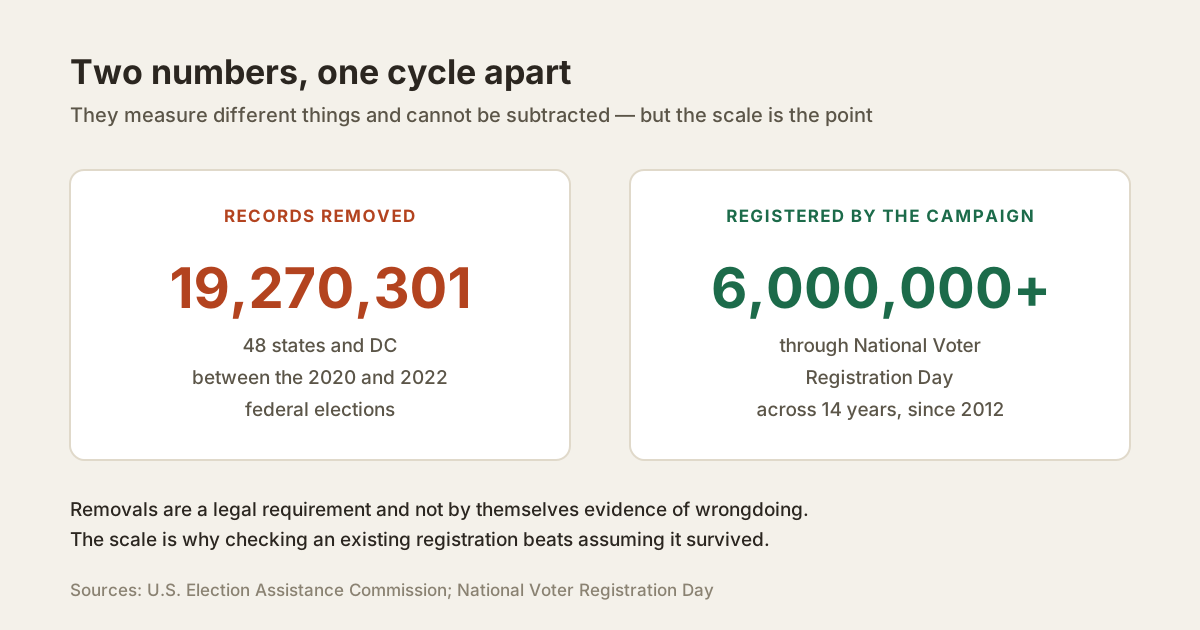
According to the U.S. Election Assistance Commission, 19,270,301 voter records were removed from the rolls of 48 states and the District of Columbia between the 2020 and 2022 federal elections. That figure is not, in itself, evidence of wrongdoing. List maintenance is a legal requirement: people die, people move out of state, people register somewhere new, and rolls that are never cleaned become inaccurate in their own way.
The difficulty is that the same processes that remove genuinely obsolete records also remove people who are still eligible and still living at the same address — and the person removed is almost never told in a way they notice.
| Item | Detail |
|---|---|
| Records removed, 2020–2022 | 19,270,301 |
| Jurisdictions reporting | 48 states and the District of Columbia |
| Governing federal law | National Voter Registration Act (NVRA) |
| “Quiet period” | NVRA bars systematic removals in the 90 days before a federal election |
| Status in 2026 | Contested — a push to reinterpret the 90-day provision, and litigation over purges in states including Ohio and Texas |
| Typical notice to the voter | A forwardable mailing; no response is often treated as confirmation |
The 90-day quiet period, and the fight over it
The NVRA bars states from conducting systematic removal programmes within 90 days of a federal election, on the straightforward logic that a voter removed in the final weeks has no realistic chance to notice and fix it. Reporting in 2026 has documented a push to reinterpret that provision more narrowly, and separately, litigation and advocacy over purges conducted in Ohio and Texas which campaigners argue breach the Act.
Who the campaign is targeting this year
Black voters and the 2024 drop
The organisers’ stated focus for National Voter Registration Day 2026 is verification among Black voters, who make up roughly 34 million eligible voters — about 14% of the American electorate — and whose participation fell noticeably in 2024 against the 2008 and 2012 cycles.
Chyann Sapp, the campaign’s director, has pointed to a cluster of obstacles: roll purges, particularly across Southern states in the wake of Callais; shifting registration deadlines and identification requirements; accessibility problems around disability accommodation and transport; and plain confusion about what the process now requires. Partner organisations on this year’s effort include Black Voters Matter and When We All Vote, and drives are being sited deliberately in libraries, food banks and on campuses rather than only online.
Those are the organisers’ characterisations of the barriers, and they are contested in the ordinary political way. The underlying facts they rest on — the removal totals, the changed Section 2 standard, the variation in deadlines — are not.
The groups at risk regardless of politics
Purge exposure is not primarily ideological. It tracks with life events, which is why it catches people across every political alignment:
- Anyone who moved, especially across county or state lines. Registration does not follow you.
- Students, who move most often and are most likely to be registered at an address they left two years ago.
- People who changed name after marriage or divorce, where a mismatch against another database can flag the record.
- Infrequent voters. In several states, not voting for a period starts the clock on a confirmation process that ends in removal.
- People with common names, disproportionately caught by cross-state matching that keys on name and date of birth.
From national campaign to county clerk
National Voter Registration Day 2026 is run nationally, but nothing about voting is administered nationally. Registration, deadlines, drop boxes, early voting hours and ballot processing are all decided and run at state and county level, which is why two Americans can follow identical advice and get different outcomes. The same fragmentation decides what happens when a Senate seat falls vacant, which states answer in strikingly different ways.
Monroe County, New York — which includes Rochester — is a useful worked example of what the national campaign actually reaches down into. The county Board of Elections is preparing for the 3 November 2026 election: poll workers in training, voting machines being tested, and community groups running registration drives in parallel with the national push.
| Stage | How a mail ballot can be returned |
|---|---|
| Any time before the election | Dropped off in person at the Board of Elections office |
| During early voting | A drop box at every early voting site |
| Election Day | Drop boxes at 210 locations across the county, positioned in direct line of sight of poll inspectors |
| By post | Standard mail return, subject to the state’s receipt deadline |
The line-of-sight detail is worth pausing on. It is a chain-of-custody measure: a box that is never out of an inspector’s view is a box whose contents can be accounted for. It is the kind of administrative decision that is invisible in national coverage and decisive in a recount.
Deadlines: the part people get wrong
There is no national registration deadline. There are more than fifty, and they differ not only in date but in kind — some states count the date you post the form, others the date it arrives; some offer same-day registration at the polls, others close registration a month out.
| State | Registration deadline | Note |
|---|---|---|
| North Carolina | 9 October 2026, 5:00 pm | Hard time-of-day cut-off |
| South Carolina | 2 October 2026 | Earliest of the examples here |
| New York | Set by state law ahead of the 3 November election | Confirm with the county Board of Elections |
| Same-day states | At the polls on Election Day | Some states only; proof of residence usually required |
How to check and fix your registration in about ten minutes
- Find your state or county election office. Search your state name plus “board of elections” or “secretary of state elections”. Use the official government domain, not an intermediary.
- Use the voter lookup tool. Nearly every state has one. You will typically need your name, date of birth and ZIP code.
- Check three fields, not one. That you are listed as active; that the address is current; that the name matches your current identification exactly.
- If anything is wrong, re-register rather than amending. In most states a fresh registration updates the existing record, and it is faster than working out which amendment form applies.
- Note your deadline and your ID requirement together. The deadline gets the attention; the ID requirement is what turns people away at the polling place.
- Check again in mid-October. Processing takes time, and a submission is not a confirmation.
Why most democracies do not need a registration day at all
For readers outside the United States, the premise can be genuinely puzzling: why would a wealthy democracy need an annual awareness campaign to get citizens onto the electoral roll? The answer is structural rather than cultural, and it is the piece almost entirely missing from American coverage of the day.
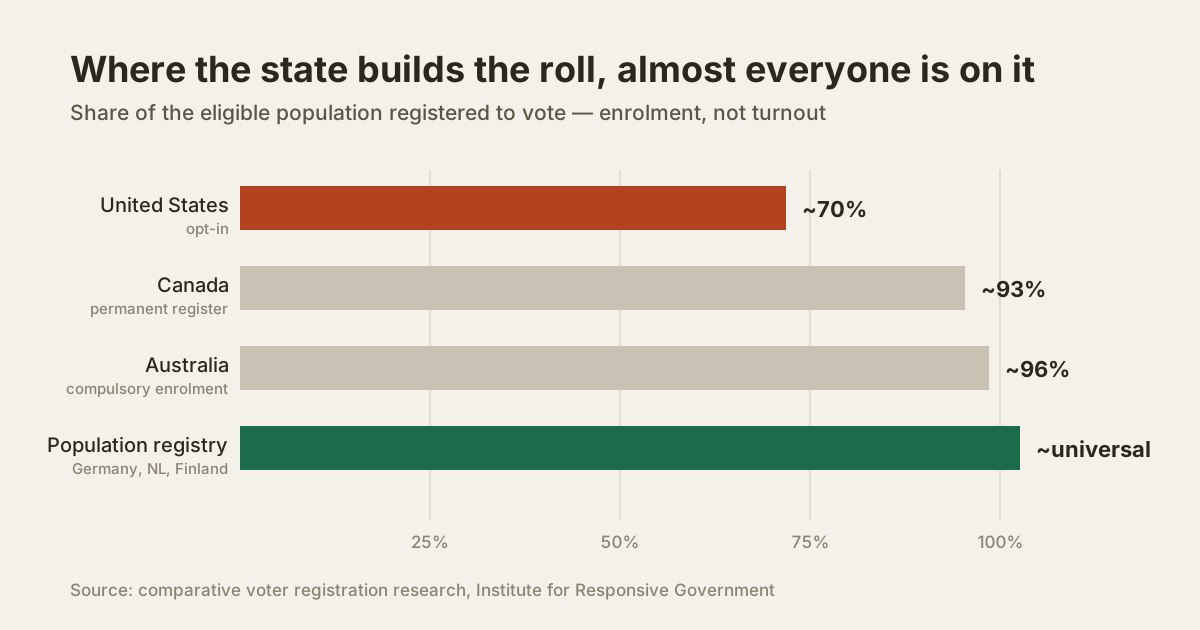
The United States is an opt-in system. The burden of getting registered, and of staying registered through every move and name change, sits with the individual. Roughly half the countries in the world do the opposite: the state builds the roll from records it already holds, and the citizen has to do nothing.
| Country | Model | Who carries the burden | Eligible population registered |
|---|---|---|---|
| United States | Opt-in registration | The individual | ~70% |
| Australia | Compulsory enrolment, automatic updating | The state (AEC) | ~96% |
| Canada | Permanent register, automatic | The state (Elections Canada) | ~93% |
| Germany, Netherlands, Finland, Iceland | Derived from population registry | The state | Effectively universal |
The mechanism matters more than the label. Australia’s Electoral Commission keeps its roll current by drawing on data it already receives from the tax office and the home affairs department, processing millions of updates a year without asking the voter to do anything. Elections Canada draws on dozens of agencies to the same end. In Germany, the Netherlands, South Korea, Norway and others, a person enters a national population registry at birth, the registry follows them through every change of address, and enfranchisement at voting age is an administrative consequence rather than an application.
A system that registers about 70% of its eligible population, against 93 to 96% in comparable federal democracies that automate it, is producing exactly the result its design implies.
What this means for November
National Voter Registration Day 2026 lands with two forces pulling in opposite directions going into the 3 November election. On one side, an organised registration effort at record scale — 2,000-plus partner organisations, a fourteen-year operational track record, and a deliberate shift in emphasis from sign-ups toward verification. On the other, a list-maintenance apparatus operating at a scale of millions of records per cycle, a narrowed Section 2 standard that makes some map challenges considerably harder to bring, and an active dispute over the one federal rule that protects voters in the final ninety days.
Which force dominates will not be visible on 15 September. It will show up in November, in the gap between the number of people who believe they are registered and the number who turn out to find that they are. That gap is measurable after the fact and almost invisible before it — which is precisely why the campaign has moved its emphasis to checking.
Final verdict
The framing of this campaign has quietly inverted, and the inversion is the story. For most of its fourteen years, National Voter Registration Day was about addition — finding people outside the system and bringing them in. In 2026 the organisers’ emphasis has moved toward verification, because the larger risk is no longer that eligible Americans were never registered. It is that they were, and no longer are, and have no idea.
The two numbers that matter sit oddly against each other. Six million people registered through this campaign across fourteen years. More than nineteen million records came off the rolls in one two-year cycle. Those measure different things and cannot be subtracted from one another — but the order of magnitude tells you where the pressure now sits, and it is not on the sign-up form.
Our read: treat Callais and the purge numbers as separate problems, because they are. The ruling changes what a vote is worth inside a district and will be fought out in redistricting litigation over years. The removals change whether a vote gets cast at all, and they are fixable this month, by one person, in about ten minutes. If you are going to act on only one of them, act on the one you control. Look yourself up, look up two people who are unlikely to, and check your state’s deadline rather than the one you half-remember.
Frequently asked
- Does National Voter Registration Day extend any deadline?
- No. It is a civic awareness campaign, not a legal instrument. Every state's registration deadline is set by that state's law and is unaffected by the date of the campaign.
- I registered years ago and have not moved. Do I still need to check?
- Yes — that is the specific case the organisers are targeting this year. Nearly 19.3 million records were removed across 48 states and DC in the 2020-2022 cycle, and in several states a period of not voting is itself enough to start a confirmation process that ends in removal.
- Did the Supreme Court ruling remove people from the voter rolls?
- No. Louisiana v. Callais, decided 29 April 2026, concerns redistricting and the standard for proving racial vote dilution under Section 2 of the Voting Rights Act. It does not itself alter registration or remove voters. The two issues are frequently conflated in coverage.
- What is the 90-day quiet period?
- A provision of the National Voter Registration Act barring states from running systematic removal programmes in the 90 days before a federal election. Its interpretation is currently contested.
- What is the single most useful thing to do today?
- Look yourself up on your state's official voter lookup tool and confirm three things: active status, current address, and a name matching your identification. If any is wrong, re-register immediately rather than waiting.