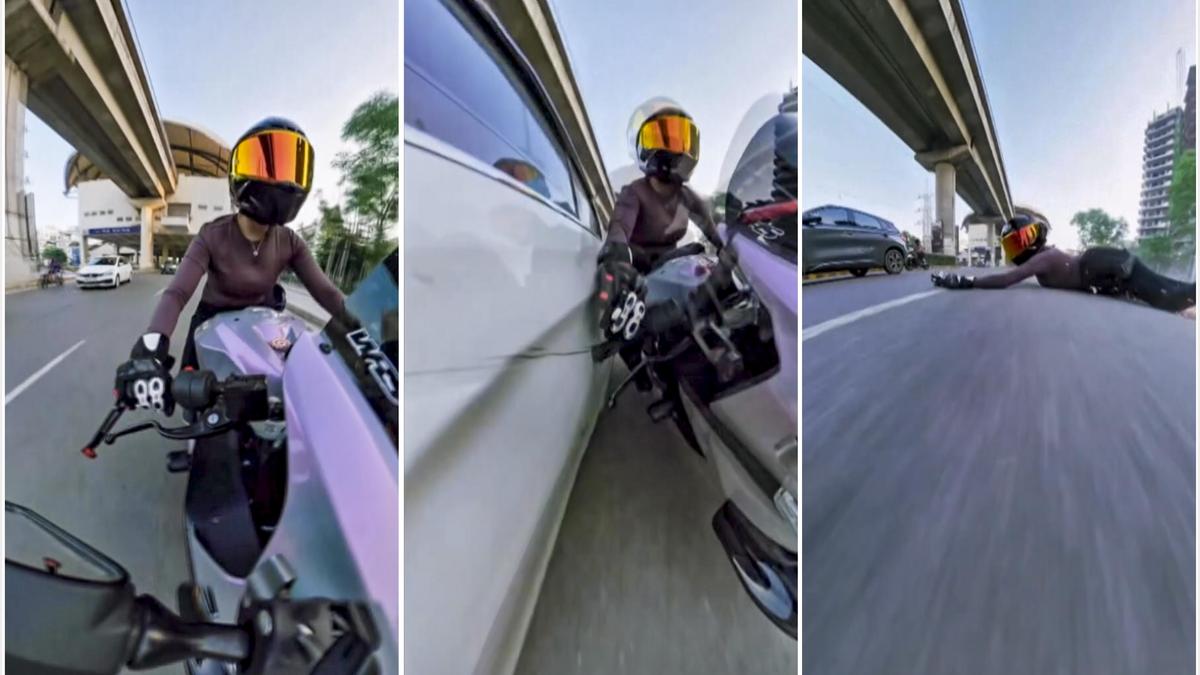
The Gurugram hit and run case involving a woman motorcyclist and a Maruti Suzuki Ciaz has moved from a routine traffic FIR to one of the most closely watched criminal matters in the National Capital Region in a matter of 48 hours. What began on Sunday morning as a collision on Golf Course Road became, by Tuesday, an arrest in Rajasthan and a charge that carries up to ten years in prison — after police said a review of CCTV footage changed their reading of what happened.
Two accounts are in circulation, and they do not agree on the most important question in the case: whether the car struck the motorcycle by accident or on purpose. What follows is what the police have said on the record, what the accused has said in his own defence, what the complainant has alleged, and where reputable outlets still contradict one another.
What is established so far
Stripping out the commentary, a small number of details are consistently reported across mainstream outlets and attributed to Gurugram Police.
| Element | Detail |
|---|---|
| Date of incident | Sunday, 13 September 2026, morning |
| Location | Golf Course Road, Gurugram, Haryana |
| Complainant | Shivani Chauhan, who uses the name Sia publicly and on social media |
| Her vehicle | Aprilia RS 457 motorcycle |
| Accused | Kalyan Bainsla, 32, of Tikri Gurjar village, Palwal district, Haryana |
| His vehicle | Maruti Suzuki Ciaz, reported to belong to a friend |
| Injuries | Thrown from the motorcycle and skidded along the road; escaped with relatively minor injuries |
| Police station | Sector 56, Gurugram |
| How the case began | Suo motu cognisance by police after video of the incident circulated widely online |
| Arrest | Tuesday, 15 September 2026, in Rajasthan |
Two details in that table are reported inconsistently and deserve to be flagged rather than asserted. The first is the point of impact: some reports describe the car striking the motorcycle from behind, while others describe it moving across lanes and hitting the bike from the side. The second is the place of arrest — reports variously locate it near Dausa and near Rajgarh, both in Rajasthan. Neither discrepancy changes the substance of the case, but both are the kind of detail that hardens into “fact” through repetition.
The charge changed, and that is the real story
The legal weight of this Gurugram hit and run case shifted substantially between Sunday and Tuesday. The original FIR was a serious but relatively ordinary traffic matter. What was added afterwards is not ordinary at all.
| Section | Offence | Stage | Maximum punishment |
|---|---|---|---|
| BNS 281 | Rash driving or riding on a public way | In the original FIR | Up to 6 months, or fine, or both |
| BNS 125 | Act endangering life or personal safety of others | In the original FIR | Varies by sub-clause; up to 3 years where grievous hurt is caused |
| BNS 109 | Attempt to murder | Added after CCTV analysis | Police have cited up to 10 years |
Why the addition matters
Sections 281 and 125 describe carelessness — driving that endangers people, whether or not anyone was targeted. Section 109 describes intent. To sustain an attempt-to-murder charge, an investigation has to show the act was done with the intention or knowledge that it could cause death. That is a far higher bar than proving bad driving, and it is the difference between a case that typically ends in a fine or a short sentence and one that can end in a decade in prison.
Gurugram Police have said the addition followed a detailed analysis of CCTV footage after video of the incident went viral. In a public statement, the force said that “playing with the law will not be tolerated at any cost” and that it was committed to strict action against the accused.
The two accounts, side by side
Both principal parties have spoken publicly. Their versions differ on intent, on what was said before the collision, and on what happened immediately afterwards.
| Question | Complainant's account | Accused's account |
|---|---|---|
| Was the collision deliberate? | Alleges a deliberate attempt to stop her, and that she was targeted because she is a woman rider | Says it was an accident and that he did not deliberately hit her |
| Was anything said beforehand? | Police have alleged indecent comments were passed before the collision | Denies gesturing; says he only told her to ride slowly |
| What happened after impact? | Says the car did not stop and no one checked whether she was safe | Has not publicly disputed leaving the scene in the reports reviewed |
| What does the footage show? | Says the video shows the car crossing lanes before hitting her motorcycle | Maintains the accidental characterisation |
Chauhan has also said publicly that her protective riding gear is the reason she is alive, a point that has been picked up widely and has driven much of the online reaction.
The relative who was travelling in the car
One thread in the coverage concerns a relative travelling with Bainsla. NDTV has reported that Bainsla’s cousin was detained in connection with indecent gestures directed at the complainant. Bainsla himself has said he was travelling with family at the time. Other reports describe the occupants of the car differently, and the research conducted for this article did not surface a police statement setting out the cousin’s status, the section he was detained under, or whether he has since been released.
Who the people in this case are
The accused
Kalyan Bainsla is 32 and from Tikri Gurjar village in Haryana’s Palwal district. Reports describe him as coming from a farming family, married with two children, and running a gym. He has publicly described himself as an international kabaddi player. Police said three teams were formed to trace him after the incident, and he was arrested in Rajasthan on Tuesday. Investigators have said they would seek remand to continue questioning.
The complainant
Shivani Chauhan rides under the name Sia and has a following as a motorcycling content creator. The machine she was riding, an Aprilia RS 457, is a mid-capacity sports motorcycle. Her decision to post her own account of the incident is what moved this from a local traffic matter to a national one — and, notably, it is what prompted police to take suo motu cognisance rather than waiting for a formal complaint to work its way through the system.
What it would actually take to prove intent
Because Section 109 is now the heaviest thing on the FIR, it is worth being precise about what the prosecution would have to establish, and what CCTV can and cannot do for them.
The burden is intent, not bad driving
An attempt-to-murder case requires showing that the act was done with the intention or the knowledge that it was likely to cause death. Careless driving, however dangerous, does not meet that standard on its own. Investigators therefore need evidence pointing at a state of mind, not merely at a collision — and in vehicular cases that evidence is almost always circumstantial.
What footage can establish
Video is strong on some questions and weak on others. It can show a vehicle changing lanes, closing distance, accelerating before impact, or following a target over a sustained stretch of road. A sequence in which a car crosses lanes specifically to reach a motorcycle, over a period long enough to rule out a momentary lapse, is the kind of thing that supports an intent argument. What footage cannot show is why. It cannot distinguish an aggressive driver from a murderous one, and it cannot by itself establish a motive such as the gender-targeting the complainant has alleged.
What investigators will look for beyond the video
- Continuity of pursuit. Footage from multiple cameras along the route, establishing whether the car tracked the motorcycle over distance or encountered it once.
- Speed and trajectory analysis. Whether the vehicle accelerated or braked in the seconds before impact.
- Statements of the other occupants. Anyone else in the car heard what was said and saw how it was driven. These statements can be decisive in either direction.
- Conduct after the collision. Leaving the scene supports a consciousness-of-guilt argument, though it is equally consistent with panic and is not proof of intent to kill.
The wider picture: how common is this?
A case like this lands in a country where road deaths are a public health emergency, and where leaving the scene of a collision is common enough to have its own grim statistical category.
| Indicator | Figure | Year |
|---|---|---|
| Traffic-related deaths, all categories | ~1.99 lakh | 2024 |
| Share attributable to road accidents | ~88% | 2024 |
| Average deaths per day | 546 | 2024 |
| Share of road deaths where speeding was a factor | 58% | 2024 |
| State with highest traffic fatalities | Uttar Pradesh, then Tamil Nadu and Maharashtra | 2024 |
| Indicator | Figure | Scope |
|---|---|---|
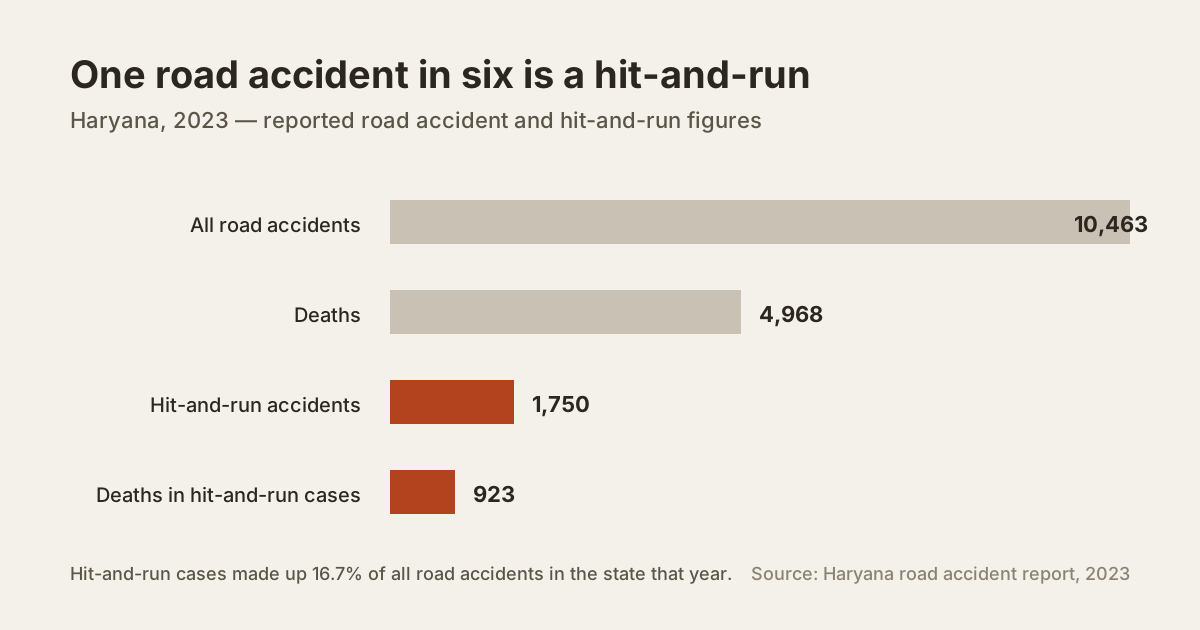
| Road accidents | 10,463 | Haryana, 2023 |
| Deaths | 4,968 | Haryana, 2023 |
| Injuries | 8,346 | Haryana, 2023 |
| Hit-and-run accidents | 1,750 (16.7% of all accidents) | Haryana, 2023 |
| Deaths in hit-and-run cases | 923 | Haryana, 2023 |
| Pedestrians and cyclists killed | 161 | Gurugram, 2023 |
| Pedestrians and cyclists injured | 353 | Gurugram, 2023 |
| Deaths on five highways through the district | 228 across 206 fatal crashes | Gurugram, 2023 |
| Deadliest stretch | Delhi–Jaipur Highway, ~3.34 deaths per km | Gurugram |
One number there explains why this case resonated. In Haryana, roughly one road accident in six is a hit-and-run, and those cases killed 923 people in a single year. The ordinary outcome of leaving the scene is that nobody is identified and nothing follows. What made this case different was not the collision. It was a camera.
Three things converted this from a statistic into a prosecution: the complainant documented it herself, the road had CCTV good enough for frame-by-frame analysis, and police acted without waiting for paperwork. Remove any one and the likely outcome is an untraced FIR.
Why this case went national
The volume of attention is not really about a single collision in one city. It attached to a specific claim: that the rider was targeted because she was a woman on a fast motorcycle. That claim has not been established, and the accused denies the characterisation. But it landed in an argument about women’s safety on Indian roads that was already running, and the footage gave that argument something concrete to point at.
It is worth separating three things that are being discussed as though they were one. Whether a collision occurred is not disputed. Whether the driver left the scene is barely disputed. Whether the collision was deliberate, and whether it was motivated by the rider’s gender, is entirely disputed — and it is the part carrying the ten-year exposure. Public certainty on the third question has run well ahead of what has been established, in both directions.
The gear question
One detail in the complainant’s account has had an outsized practical effect on the conversation: her statement that protective riding gear is the reason she survived being thrown from a motorcycle at road speed and skidding along the surface.
That is consistent with what trauma data on motorcycle crashes has long shown. The injuries that kill riders in this kind of impact are head trauma and, in survivable crashes, the abrasion and fracture injuries caused by contact with the road surface. A full-face helmet, an abrasion-resistant jacket and trousers, gloves and armoured boots do not prevent a crash. They change the outcome of one from life-altering to recoverable.
India’s legal requirement stops at a helmet. The rest is voluntary, expensive, and routinely skipped in heat and traffic. This case has become, somewhat incidentally, the most widely circulated argument for the rest of it in years — which is worth noting even though it has nothing to do with the question of who is criminally liable.
What happens next
For readers following the Gurugram hit and run case as it develops, the procedural path from here is reasonably predictable.
- Production and remand. The accused is produced before a magistrate, and police seek custody for questioning. The length granted signals how much investigation the court accepts is outstanding.
- Evidence work. CCTV from multiple points along the route, the vehicle itself, phone location data, and statements from the other occupants of the car.
- Bail applications. With BNS 109 on the FIR, bail becomes considerably harder to obtain than it would have been on the original sections alone.
- Chargesheet. The decisive document. If investigators retain Section 109, they believe they can prove intent. If it is dropped, the case returns to a rash-driving prosecution.
- Trial. Where the competing accounts are finally tested against evidence rather than against each other on social media.
Final verdict
Two things about this case are worth holding onto once the volume drops.
The first is that the entire prosecution rests on evidence that very nearly did not exist. A rider who chose to document and publish what happened to her, and a stretch of road with CCTV good enough to analyse frame by frame, are the reasons this is a criminal case rather than one of the 1,750 hit-and-run entries Haryana logs in a year. That should be read as a warning about the other 1,749, not as reassurance about this one.
The second is that the added attempt-to-murder charge is the single most consequential development, and also the most uncertain. Moving from rash driving to Section 109 means the state is asserting intent, which is the hardest thing in criminal law to prove. Police clearly believe the footage supports it. Whether a chargesheet sustains it, and whether a court eventually accepts it, are open questions that the noise around this case has largely skipped past.
Our read: the facts of the collision are not seriously in dispute. The motive is, and it is being argued publicly by people who have seen a video clip rather than an investigation file. The responsible position — for readers, and for anyone writing about it — is that Kalyan Bainsla stands accused of a serious offence, that Shivani Chauhan has made serious allegations, and that the chargesheet, not the trending timeline, is where this gets decided.
Frequently asked
- Has Kalyan Bainsla been convicted?
- No. He has been arrested and charged. The charges are allegations and the case has not been tried. Nothing in the public record at this stage constitutes a finding of guilt.
- What is Section 109 of the BNS?
- It is the attempt-to-murder provision of the Bharatiya Nyaya Sanhita. Police have said it carries up to ten years' imprisonment. It was added to this FIR after investigators reviewed CCTV footage; it was not in the original complaint.
- Why did police register a case without a formal complaint?
- They took suo motu cognisance — acting on their own initiative — after video of the incident circulated online. This is permitted and is not unusual in cases that attract significant public attention.
- Was the rider seriously injured?
- Reports indicate she escaped with relatively minor injuries despite being thrown from the motorcycle and skidding along the road. She has publicly credited her protective riding gear.
- What is still unverified in the Gurugram hit and run case?
- Whether the collision was deliberate; the exact point of impact, which is described differently across outlets; the precise location of the arrest in Rajasthan; and the status of the relative reported by NDTV to have been detained.